
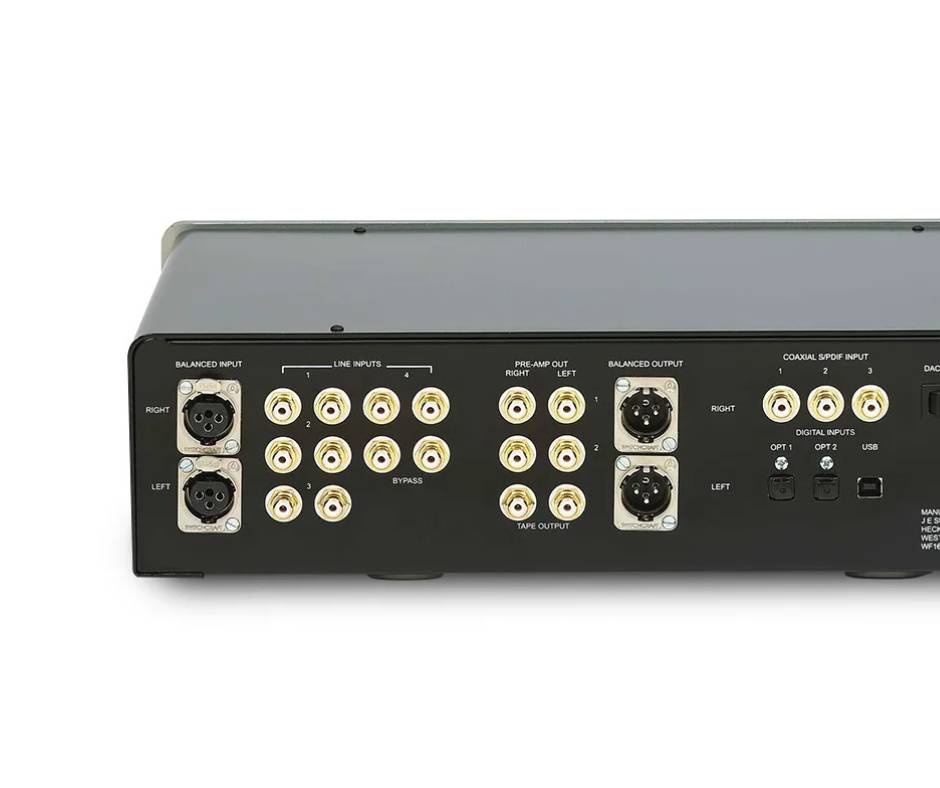
Bit depth and sample rate define the resolution of digital audio, determining how accurately a DAC can reconstruct the original analogue waveform from discrete samples. This reconstruction is performed by a digital-to-analogue converter, explained in detail in our guide to what a DAC is, and these specifications shape dynamic range, noise floor, frequency response and overall clarity.
What Bit Depth Really Means
Bit depth—sometimes called word length or amplitude resolution—defines how many possible volume steps are available for each sample. More bits allow finer gradations in loudness, creating smoother transitions and reducing quantisation noise.
Common Bit Depths
- 16-bit: Standard for CDs; offers 96 dB of dynamic range
- 24-bit: Typical for hi-res audio; offers 120 dB+ of dynamic range
- 32-bit float: Used in production; provides enormous headroom
A higher bit depth does not make a recording louder—it allows more precise representation of quiet and subtle details without distortion or noise.
How Bit Depth Affects Sound
- Lower noise floor and cleaner background
- Greater dynamic expression, especially in acoustic recordings
- Smoother microdetail in low-level passages
- Reduced quantisation artefacts such as grain or digital harshness
In practice, 24-bit audio allows DACs to operate with more headroom and less distortion, even if final listening levels rarely use the full dynamic range.
What Sample Rate Really Means
Sample rate—or sampling frequency—specifies how many times per second the signal is measured. Higher sample rates capture more time-domain detail and allow wider frequency response.
Common Sample Rates
- 44.1 kHz: Standard for CDs
- 48 kHz: Video and broadcast standard
- 88.2 / 96 kHz: Hi-res, more accurate filtering
- 176.4 / 192 kHz: Ultra-high-res formats
- 352.8 / 384 kHz: DXD and extreme high-resolution mastering
Because of the Nyquist theorem, a 44.1 kHz sample rate supports frequencies up to roughly 22 kHz—just above the range of human hearing.
How Sample Rate Influences Sound
While higher sample rates don’t necessarily mean “better” sound in all cases, they offer technical benefits:
- Smoother high-frequency behaviour
- More relaxed filtering and fewer artefacts
- Improved transient accuracy
- Cleaner reconstruction in the DAC
These advantages are subtle but can enhance spatial realism and treble refinement.
How Bit Depth and Sample Rate Work Together
Bit depth governs vertical resolution (volume precision), while sample rate governs horizontal resolution (timing detail). Together they determine the overall fidelity of a digital recording.
A high sample rate with low bit depth would offer extended bandwidth but limited dynamic range. A high bit depth with a low sample rate would provide excellent dynamics but limited high-frequency extension. Modern hi-res formats combine both improvements.
Common Misconceptions
“Higher sample rates always sound better.”
Not necessarily. The audible improvement depends on the DAC’s architecture, analogue stage, reconstruction filters and the quality of the original recording.
“24-bit audio is only useful for professionals.”
While originally designed for recording engineers, 24-bit delivery formats give DACs more headroom and cleaner reproduction, even if the listener never uses the full dynamic range.
“Human hearing can’t go above 20 kHz, so higher sample rates are pointless.”
Higher sampling frequencies influence filter behaviour, phase response and harmonic accuracy—factors that can affect perceived realism even if ultrasonic content is not directly audible.
Real-World Listening Impact
In well-designed DACs, bit depth and sample rate improvements manifest as:
- Greater clarity in quiet passages
- More natural treble with less “digital edge”
- Improved stereo imaging and depth
- Lower distortion during complex mixes
These benefits depend on both recording quality and playback chain, but when implemented properly, they contribute to a more lifelike, expressive presentation.
In practice, the audible benefits of higher bit depth and sample rates are most apparent when the playback chain includes a well-designed converter, explored further in our guide to why external DACs improve sound quality.
Looking to upgrade your system now? Explore our full DACs range.
Final Thoughts
Bit depth and sample rate define the resolution of digital audio and shape dynamic range, noise performance, timing accuracy and overall fidelity. A modern DAC leverages these specifications to reconstruct analogue waveforms with precision. Whether listening to standard CD quality or high-resolution files, understanding how these parameters interact helps you choose the formats and equipment that best complement your system and listening preferences.


