
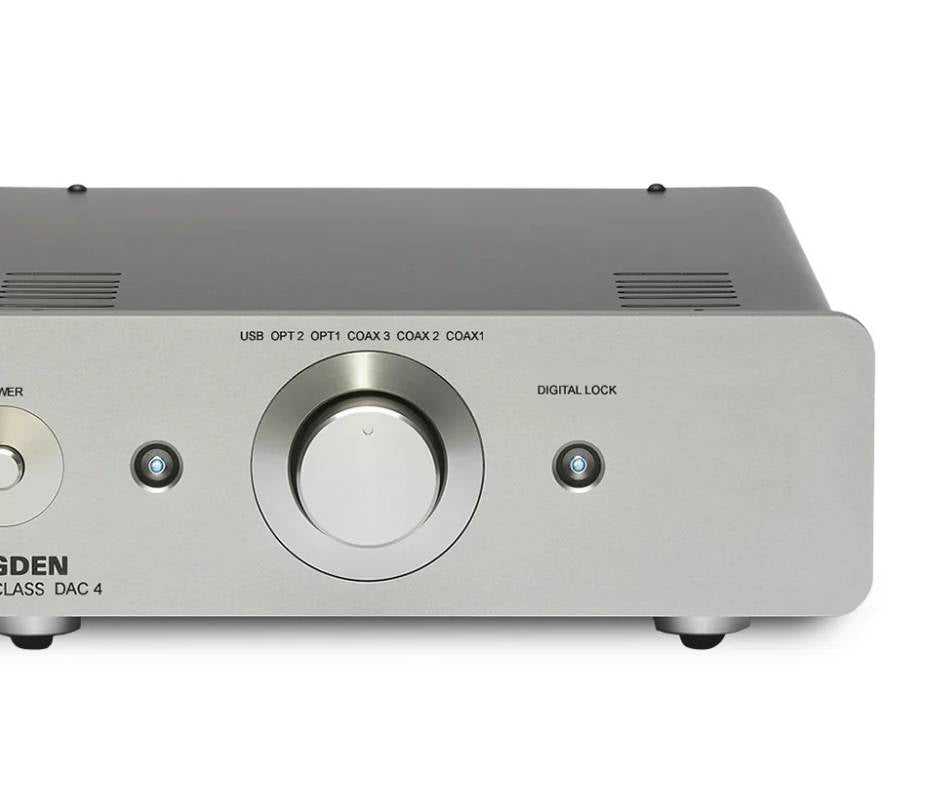
Digital-to-analogue conversion is the process of transforming discrete digital samples into a smooth, continuous electrical waveform that amplifiers and speakers can reproduce. This process is carried out by a digital-to-analogue converter, explained in detail in our guide to what a DAC is, using a combination of signal processing, precision clocking, filtering and analogue circuitry.
The Journey from Data to Music
Every digital audio file—whether high-resolution FLAC, WAV, PCM, DSD or even streaming formats—contains numerical snapshots of a waveform. These samples represent amplitude at specific moments in time. The DAC’s job is to read these values, correct timing errors, reconstruct the missing information between samples and output a clean, natural analogue signal.
1. Receiving and Synchronising the Digital Data
The conversion process begins when the DAC receives data through USB, optical, coaxial or network audio streams. The incoming signal must be synchronised using an internal clock or oscillator. This clock establishes the timing reference for playback and reduces jitter—tiny timing inconsistencies that blur detail and flatten soundstage depth.
High-quality DACs incorporate low-phase-noise crystal clocks or advanced asynchronous USB interfaces to stabilise timing and preserve micro-detail.
The precision of these processes depends heavily on the resolution and timing of the incoming data, which is determined by bit depth and sample rate, explained in our guide to bit depth and sample rates.
2. Digital Processing, Oversampling and Filtering
Before actual conversion takes place, many DACs apply oversampling, interpolation and digital filtering to refine the incoming data. Oversampling increases the effective sample rate, allowing gentler analogue filters to be used later. Interpolation algorithms fill in transitional values, helping reconstruct smoother waveforms.
This digital manipulation—sometimes referred to as preprocessing, conditioning or upscaling—reduces aliasing, noise and distortion.
3. Converting Samples to Analogue Voltage
At the core of the converter lies the silicon responsible for generating real analogue voltages from digital words. Different DAC architectures approach this in unique ways:
- Delta-Sigma DACs: use noise-shaping and high-rate modulation for efficient, low-distortion conversion.
- R-2R ladder DACs: use precision resistor networks to create highly linear analogue outputs.
- Multibit DACs: combine robustness with consistent output steps.
- FPGA-based DACs: implement custom digital filters and proprietary conversion logic.
Regardless of architecture, the goal is identical: translate binary data into accurate voltage changes that form the basis of the analogue waveform.
4. Reconstruction Filtering
Once the analogue output is formed, it contains high-frequency artefacts produced by the sampling process. A reconstruction filter removes these unwanted components while preserving musical transients and harmonic integrity. This filtering stage is crucial for maintaining smoothness, clarity and natural tonal behaviour.
Some designs use steep linear-phase filters, others prefer minimum-phase or hybrid approaches to shape the sonic character. Even though the terms may vary—analogue filter, smoothing stage, low-pass network—they all perform the same function.
5. Analogue Output Stage
After filtering, the analogue waveform passes through an output stage that sets voltage level, lowers impedance and ensures a clean signal path. This stage can be implemented using op-amps, discrete transistors or even valves, each imparting its own tonal flavour and dynamic behaviour.
The quality of the output stage affects bass solidity, treble refinement, imaging precision and overall transparency.
Why Some DACs Sound Better Than Others
Although the underlying mathematics of digital audio is consistent, execution varies dramatically between devices. The following factors heavily influence final sound quality:
- Clock accuracy and jitter reduction
- Analogue output topology and component quality
- Power supply regulation and noise isolation
- Digital filter design and oversampling algorithms
- Architecture (delta-sigma, multibit, R-2R, FPGA)
This is why listeners often describe DACs as more “analytical,” “smooth,” “warm,” “neutral,” “detailed” or “dynamic.” These sonic signatures arise from implementation choices, not the basic conversion principle.
Real-World Example: USB Audio
When a computer sends audio over USB, the DAC must:
- Receive and buffer the incoming data
- Reclock the stream to stabilise timing
- Oversample and filter the signal
- Convert digital samples into voltage
- Filter and output the analogue waveform
The difference between a basic USB dongle DAC and a high-end converter is the sophistication of each of these steps.
Looking to upgrade your system now? Explore our full DACs range.
Final Thoughts
Digital-to-analogue conversion is a complex, multi-stage process that transforms raw digital data into the fluid, continuous signal required for music playback. A DAC takes responsibility for synchronising, processing, converting and filtering the signal with precision. When executed well, the result is a transparent, lifelike and emotionally engaging listening experience. Whether integrated inside a device or implemented in a dedicated external unit, the DAC remains the heart of all digital audio reproduction.


