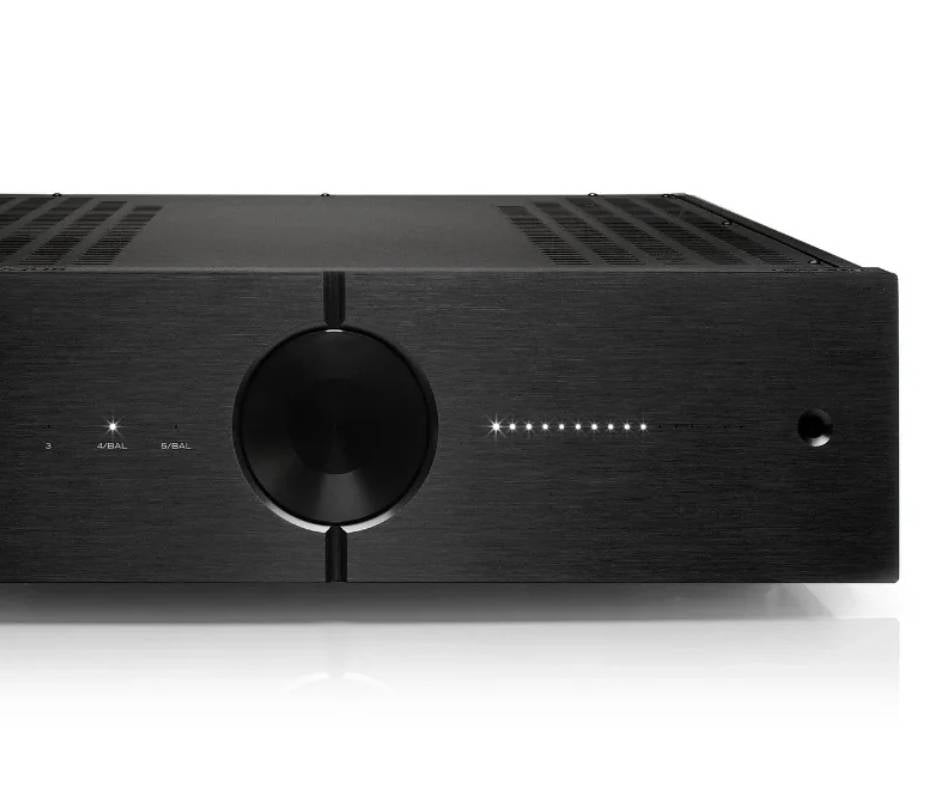

A phono preamplifier is an audio component that amplifies the low-level signal from a turntable cartridge and applies RIAA equalisation so it can be played through a standard amplifier or powered speakers. Unlike line-level sources such as DACs or CD players, phono cartridges output extremely low voltages and require specialised gain, impedance matching and tonal correction to produce accurate, lifelike sound.
Why a Phono Preamplifier Is Essential
Turntable cartridges generate tiny electrical signals—between 0.2 mV and 5 mV depending on type. This signal is too quiet and tonally unbalanced to feed directly into a line-level input. A phono preamplifier (also called a phono stage, phono amp, or RIAA preamp) performs two critical functions:
- 1. Amplification: boosts the cartridge output to line level
- 2. Equalisation: applies the RIAA curve to restore correct frequency balance
Without a phono stage, vinyl playback would sound extremely quiet, thin, bright and lacking in bass.
How a Phono Preamplifier Works
A phono stage compensates for how records are cut. During mastering, engineers reduce low frequencies and boost high frequencies to fit more music onto vinyl and minimise groove distortion. The phono preamp then performs the inverse process—restoring the original tonal balance.
Key Functions
- Voltage gain to raise the tiny cartridge signal
- Impedance matching to optimise cartridge loading
- RIAA equalisation to correct the frequency response
- Noise suppression through clean circuitry and shielding
High-quality phono stages preserve transient detail, imaging precision and low-frequency weight with minimal distortion.
Different Types of Phono Preamplifiers
1. MM (Moving-Magnet) Phono Preamps
Designed for cartridges with higher output (4–6 mV) and standard loading of 47 kΩ. MM stages typically require less gain and offer a smoother, warmer sonic profile.
2. MC (Moving-Coil) Phono Preamps
Built for low-output cartridges (0.2–0.8 mV) that demand higher gain, lower noise and adjustable impedance loading. MC stages are more revealing and often used in high-end analogue systems.
3. Hybrid or Switchable Phono Stages
Many modern units allow switching between MM and MC modes, providing flexibility for cartridge upgrades.
How a Phono Stage Affects Sound Quality
1. Dynamics and Energy
Proper gain ensures musical peaks are reproduced cleanly without compression or distortion.
2. Noise Floor
Because cartridge signals are extremely delicate, any noise introduced by the preamp becomes audible. High-quality phono stages use low-noise components to maintain clarity.
3. Tonal Balance
Accurate RIAA equalisation restores rich bass, natural mids and extended treble. Poorly implemented EQ can make vinyl sound dull, bright or unbalanced.
4. Stereo Imaging
Clean amplification preserves microdetail and spatial cues, enhancing depth and soundstage width.
5. Cartridge Compatibility
Adjustable gain and loading let cartridges operate at optimal performance, unlocking greater detail and musical nuance.
Where the Phono Preamplifier Sits in the Signal Chain
A phono stage is placed between the turntable and your amplifier:
- Turntable → Phono Preamplifier → Integrated Amplifier / Receiver / Active Speakers
Some integrated amps include built-in phono stages, but dedicated external units often offer cleaner circuitry, better components and superior sonic performance.
Signs You Need a Better Phono Stage
- Dull or lifeless presentation
- Excessive noise or hum
- Sibilance or distortion during vocal peaks
- Weak bass response
- Compressed or flat soundstage
Upgrading the phono stage is one of the most transformative improvements in a vinyl playback system.
If you’re building a system around analogue sources, explore our full range of Phono Preamps, designed to match a wide variety of cartridges, turntables and amplifier types.
Final Thoughts
A phono preamplifier is a vital component of any turntable setup, responsible for amplifying the cartridge signal and restoring the correct frequency balance through RIAA equalisation. Its gain structure, noise performance and loading settings directly shape the clarity, dynamics and tonal character of vinyl playback. Whether you are using an MM or MC cartridge, choosing a properly matched phono stage unlocks far greater musical detail and brings your records to life.