

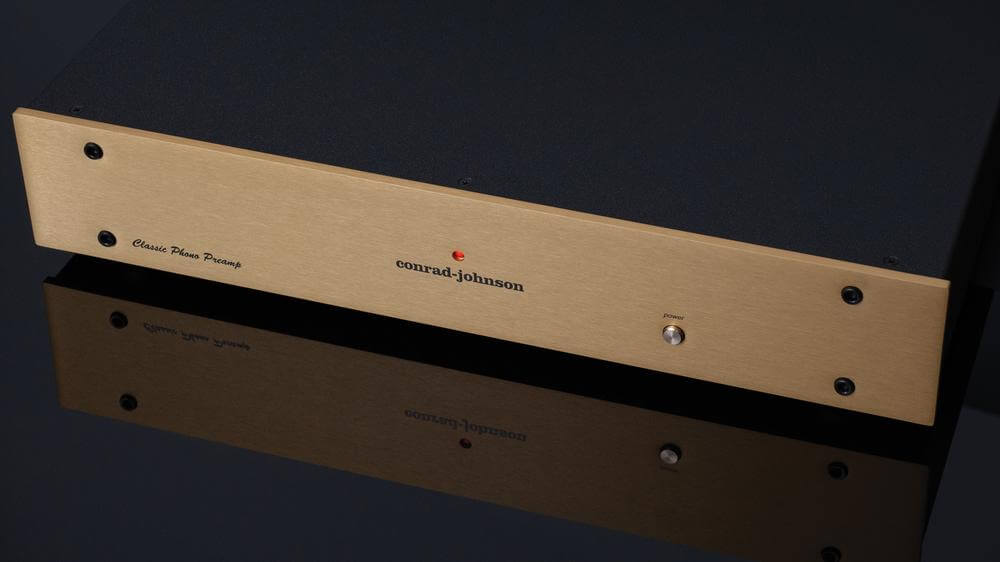

Conrad-Johnson Classic Phono SE Equalization Preamplifier
Conrad-Johnson Classic Phono SE is a valve phono stage that connects a turntable to any preamp, integrated amp or receiver lacking a phono input. You’ll order 53 dB high gain for cartridges rated at 1.0 mV or below, or 40 dB low gain for hotter models, so the input won’t overload. Internal DIP switches set loading from 160 ohms to 47 kilohms to match your cartridge. Its zero-feedback triode circuit tracks the RIAA curve through a passive 1%-tolerance network. The SE version upgrades 12 resistors and 17 capacitors to laser-trimmed metal foil and CJD Teflon parts.
Limited Availability - Contact Us Before Purchasing.
✓ Full Australian Warranty
✓ Fast Australia-Wide Shipping
✓ Local Expert Support
Specifications
Product Details
Is the Conrad-Johnson Classic Phono SE the Right Valve Phono Stage for Your Turntable?
The Conrad-Johnson Classic Phono SE is a vacuum-tube phono equalisation preamplifier for vinyl owners who want an all-triode signal path with no feedback, matched to one specific cartridge. It’s the upgraded version of Conrad-Johnson’s Classic Phono. It uses the same circuit but replaces 29 resistors and capacitors with laser-trimmed metal foil and CJD Teflon parts. The Classic Phono SE sits between your turntable’s tonearm and a line-level input. It comes in two fixed-gain versions: 53 dB for low-output cartridges and 40 dB for higher-output designs. That suits listeners who’ve settled on a cartridge and want a phono stage set up around it, not one built to switch between many.
How Does Its Zero-Feedback Triode Circuit Work?
The Classic Phono SE is a zero-feedback design, so there’s no negative feedback loop around its gain stages. Most amplifier circuits send part of the output back to the input to lower distortion and widen bandwidth. Conrad-Johnson’s view is that this loop adds timing errors to the signal. The Classic circuit avoids the loop. It gets wide bandwidth and low distortion from a simple topology that’s carefully implemented.
The audio path runs through three single-ended triode stages. Two cascaded triode gain stages amplify the cartridge signal, and a triode cathode follower buffers the output. The input stage uses a pair of 12AX7 twin triodes with both sections of each valve wired in parallel. This lowers noise at the point where the cartridge’s tiny signal is most exposed to it.
RIAA equalisation is handled by a passive network between the two gain stages. Records are cut with the bass reduced and the treble boosted. The phono stage has to apply the exact inverse curve to restore a flat tonal balance. The Classic Phono SE builds this network from 1% tolerance parts so its response tracks the published RIAA curve closely. Because the equalisation is passive, the curve doesn’t depend on a feedback network to set it.
Separate regulated power supplies feed the amplifier stages. They’re designed to keep a low impedance even at the highest audio frequencies. They isolate each stage from the AC mains and from the other stages. This keeps mains irregularities, and stages interacting through a shared supply, from reaching the audio signal.
What Does It Gain Over the Standard Classic Phono?
The Classic Phono SE is the parts-upgraded version of the standard Classic Phono. It has the same circuit, gain options, loading and connections, with a higher grade of component in the most critical positions. Both models use polypropylene capacitors and precision metal film and metal foil resistors throughout the audio circuit and power supplies. The SE adds two changes:
- Twelve of the most critical resistors in the audio circuit are replaced with laser-trimmed metal foil resistors.
- Seventeen capacitors are replaced with CJD Teflon capacitors, including the coupling capacitors between stages and the critical bypass capacitors.
Capacitor “memory” is dielectric absorption: after the voltage across a capacitor changes, its dielectric holds a little leftover charge and releases it later. Coupling capacitors carry the full audio signal from one triode stage to the next, so their dielectric sits directly in the signal path. Conrad-Johnson chose Teflon for these positions because of its low memory. If you’re choosing between the two Classic models, the difference is limited to component grade. Everything you’ll set up, connect and maintain is the same.
Who Should Choose the Classic Phono SE Over Other Phono Stages?
The Classic Phono SE is aimed at analogue listeners building a separates system around one turntable, one tonearm and a cartridge they plan to keep. Its strongest appeal is to buyers who specifically want a triode valve stage with no feedback, compared with feedback-based solid-state or valve phono stages.
There are four things to weigh before you buy:
- Frequent cartridge swapping. Gain is fixed by version, with no front-panel or remote gain switch. If you move between a low-output moving-coil and a moving-magnet cartridge, factor this in.
- Load experiments. Cartridge loading is resistive and is set with switches inside the chassis. That’s practical for setting once, not for comparing loads during listening.
- Two-arm turntables. The manual describes a single set of inputs for one tonearm.
- Systems without a line stage. The power switch is the only user control. Volume and source selection stay with your preamplifier, integrated amplifier or receiver.
Valve ownership is part of the decision. The valves have to be replaced periodically and the unit needs to warm up, which is the trade-off against a solid-state phono preamp.
Which Classic Phono SE Gain Version Suits Your Cartridge?
The Classic Phono SE is ordered in a high-gain (53 dB) or low-gain (40 dB) version, and your cartridge’s rated output decides which one you need. Conrad-Johnson recommends the high-gain version for cartridges rated at 1.0 mV or below, which typically means low-output moving-coil designs. Its input overloads at 10 mV. A higher-output cartridge can drive it into overload and excessive distortion, so it isn’t recommended for those.
For cartridges rated above 1.0 mV, choose the low-gain version. Moving-magnet, moving-iron and high-output moving-coil cartridges usually fall in this range. It can accept up to 50 mV before overload, which gives it more headroom for higher-output cartridges.
Working from the two gain figures, a 0.4 mV moving-coil cartridge into 53 dB gives roughly 180 mV. A 5 mV moving-magnet cartridge into 40 dB gives roughly 500 mV. The two versions differ in valves as well as resistors. The high-gain unit uses a 12AX7 for its second gain stage, while the low-gain unit uses a lower-gain 12AU7. Choose the version that suits the cartridge you plan to keep, because gain can’t be switched on the unit.
How Do You Match Cartridge Loading to It?
The Classic Phono SE is fitted with switch-selectable resistive loading, adjustable from 160 ohms to 47 kilohms. The available settings are 47 kΩ, 9.6 kΩ, 2.4 kΩ, 560 Ω, 460 Ω, 250 Ω and 160 Ω. It leaves the factory set to 47 kΩ, the standard load for moving-magnet cartridges. The lower settings cover the range moving-coil manufacturers commonly specify. Start with the load your cartridge maker recommends.
The settings are made on a pair of four-position DIP switches mounted on the circuit board near the input connectors, one for each channel. Unplug the unit from the mains before you remove the cover. Set both channels identically.
How Does the Classic Phono SE Connect to Your Amplifier?
The Classic Phono SE is a phase-correct (non-inverting) stage with an output impedance below 750 ohms. It feeds any line-level input on a preamplifier, integrated amplifier or receiver. The low output impedance comes from the valve cathode follower in the output stage. It lets the Classic drive the interconnect’s cable capacitance and the input of the next component without the source impedance shaping the signal.
Because the Classic Phono SE doesn’t invert phase, your system’s absolute phase depends on the other components. If the rest of your chain has an odd number of phase inversions, reverse the positive and negative speaker connections on both channels to correct it.
A time-delay muting circuit protects the components downstream. Relays ground the outputs for about two minutes after switch-on to block warm-up transients. They also ground the outputs immediately at switch-off or if the mains power drops out. Expect two minutes of silence after you turn it on.
Where Should It Be Placed in Your Rack?
The Classic Phono SE is a full-width component, about 483 mm wide, 346 mm deep and 92 mm high, weighing about 5.9 kg. Check that your rack shelf takes a standard 19-inch-wide chassis.
The valves need airflow. Mount the unit horizontally on a flat, hard surface, and keep the ventilation holes in the base clear. Leave at least 50 mm of clearance above the chassis, and keep the shelf or cabinet open at the back so warm air can escape.
How Do You Keep Hum and Interference Out of the Installation?
The Classic Phono SE is built to resist radio-frequency and electromagnetic interference through its choice of materials, physical layout, grounding and power supply design. Conrad-Johnson deliberately left out heavy RFI filtering to avoid compromising audio performance. If an EMI problem does occur, it’s treated locally rather than designed out for every installation. That puts the weight on careful installation:
- Keep interconnects as short as possible, at 3 metres or less.
- Use shielded interconnect with two centre conductors and a separate outer shield connected at one end only.
- Place the phono stage well away from your power amplifier to reduce hum pickup.
- Route mains cords at least 100 mm away from the input and output cables.
Which Mains Voltage Does the Classic Phono SE Need?
The Classic Phono SE is configured at the factory for one mains supply. US units run on 108 to 126 volts at 60 Hz. Export versions have their operating voltage and frequency marked on the back panel, next to the power cord. Before buying for a 230 to 240 volt supply, such as Australia’s, confirm that the rear-panel marking matches your mains. Actual line voltage should stay within +5% / −10% of the rated figure.
The power transformer is protected by a fuse in a pull-out tray inside the AC power inlet. Units configured for 220 or 240 volts use a 5 × 20 mm T400mA time-delay fuse, and 100 or 120 volt units use T800mA. A blown fuse points to a more serious fault, so have a qualified technician inspect the unit. Never fit a fuse of a different value or type.
What Does Owning a Classic Phono SE Involve?
The Classic Phono SE is a four-valve design built on twin-triode vacuum tubes. The high-gain version uses three 12AX7s and one 12AU7. The low-gain version uses two 12AX7s and two 12AU7s. Conrad-Johnson expects the valves to last two to three years of normal use without degradation if you switch the unit off when you’re not listening. Left on all the time, they can wear out in a few months.
The factory valves are burned in under a controlled process, then selected for the lowest residual noise. Matched replacement sets are prepared and selected the same way. After the two-minute mute, allow about 15 minutes for the valves and circuit to reach a stable operating temperature before critical listening.
Shipping & Delivery
This product is available for delivery throughout Australia. Orders ship from Queensland.
Free Australia-wide shipping on eligible orders. See our Delivery & Shipping Policy .