Conrad-Johnson ET6/ET6SE Valve Preamplifiers: Which Version Belongs in Your System?
The Conrad-Johnson ET6/ET6SE is a zero-feedback vacuum-tube preamplifier offered in two grades, and both bring the line-stage circuit of conrad-johnson's former GAT flagship into the company's entry-level range. The standard ET6 and the upgraded ET6SE share the same circuit, connections and features. The SE adds higher-grade capacitors and resistors in critical circuit positions. Either version comes as a line stage alone or with a factory-fitted phono stage. Both suit listeners building a two-channel system around a valve preamp who want remote control, a relay-switched stepped attenuator and the option of integrated vinyl playback.
What makes the Conrad-Johnson ET6/ET6SE different from other entry-level valve preamplifiers?
The Conrad-Johnson ET6/ET6SE is a direct descendant of the GAT, a flagship line stage that conrad-johnson no longer manufactures. A single triode valve provides the voltage gain, and the circuit runs without global negative feedback. DC voltage regulators feed that circuit, and the whole arrangement closely replicates the GAT's topology.
Without a feedback loop, the circuit's behaviour rests on the triode's own linearity rather than on correction applied from output to input. The regulated supply exists to give the valve stable operating voltages, so the circuit holds the operating point its designers set.
The optional phono stage follows the same approach. It borrows its zero-feedback audio circuit from conrad-johnson's reference TEA1-S3 phono stage, and it's built to the same standard as the line stage.
Should you choose the ET6 or the ET6SE?
The ET6SE is the same preamplifier as the ET6 with upgraded parts in critical circuit applications, so the choice comes down to component grade rather than features. The standard ET6 uses precision metal-film resistors for low noise, and polypropylene capacitors are used exclusively in its audio circuits and regulated plate voltage supplies. Polypropylene's low dielectric absorption means the capacitor releases stored charge with minimal lag, which helps preserve the timing of musical transients.
The ET6SE replaces parts in critical positions with CJD Teflon capacitors and metal-foil resistors. Every other aspect described here applies to both models equally, including gain, inputs, phono options, installation and valve complement. Buyers who want those component upgrades from the outset should choose the SE. Buyers who want the shared circuit and feature set at the entry point of the range should choose the standard ET6.
How does the stepped attenuator change volume control?
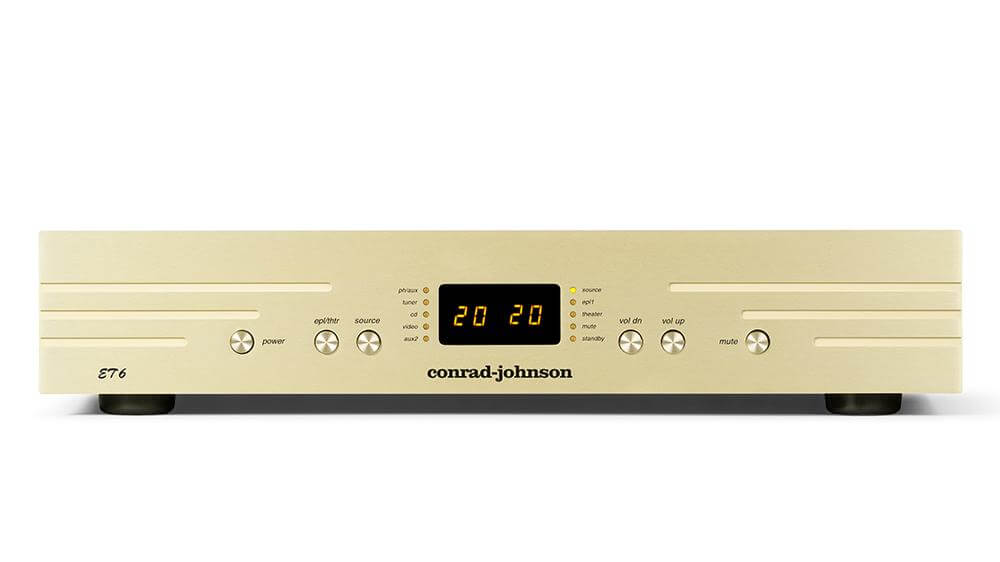
The ET6/ET6SE level control is a relay-operated discrete stepped attenuator, the same type conrad-johnson uses in the GAT and the ET7. Relays switch fixed resistor networks in and out of the signal path rather than sweeping a wiper across a conventional potentiometer track. Each press of the volume button moves the level by about 0.7 dB, and holding the button cycles through the steps at an accelerating rate. A two-digit display for each channel shows the setting.
Fixed resistors give repeatable steps, so a given number on the display always returns the same gain. Both models omit the balance function found on the ET7 and GAT. Rooms with asymmetric speaker placement will need to correct channel balance through positioning, and the balance buttons on the remote have no effect.
Which Conrad-Johnson ET6/ET6SE phono stage suits your cartridge?
The Conrad-Johnson ET6/ET6SE phono stage is available in two factory-fitted versions, and the right one depends on your cartridge's rated output. The high-gain card provides 54 dB of gain and suits cartridges rated at 1 mV or below, which covers most low-output moving-coil designs. The low-gain card provides 40 dB and suits cartridges rated above 1 mV, such as moving-magnet, moving-iron and high-output moving-coil models.
Matching matters for a mechanical reason. A high-gain card driven by a high-output cartridge produces enough signal to overload the line stage's input, and the result is heavily distorted sound. A rear-panel label and a label on the card itself identify which version is fitted. Because the card is installed at the factory, it's worth choosing with future cartridge upgrades in mind.
RIAA equalisation sits within ±0.25 dB of the standard curve from 20 Hz to 20 kHz. Units without a phono card use the AUX1/PH input as an extra line-level input.
How is cartridge loading adjusted?
The phono-equipped ET6 or ET6SE is fitted with two internal DIP switch arrays that set cartridge loading, one per channel, located near the rear input connectors. Both phono cards ship at 47 kOhms, the standard load for moving-magnet cartridges. Moving-coil users can select 9.6 kOhms, 1.9 kOhms, 500 Ohms or 200 Ohms to suit the cartridge maker's recommended load.
Changing the load means unplugging the preamplifier from the mains and removing the cover. Each array has four switches, and turning on a single switch selects one of the lower values. Both arrays must be set identically, and the cover goes back on before the unit is powered up. Because loading isn't adjustable from the front panel, it's a set-and-forget adjustment made once per cartridge rather than something to experiment with during a listening session.
Is it electrically compatible with the rest of your system?
The ET6/ET6SE is a high-gain line stage with 25 dB of gain, a 100-ohm output impedance and a maximum output of 20 Vrms. That low output impedance lets it drive interconnects and amplifier inputs comfortably, and the 20 Vrms ceiling sits well above the input sensitivity of typical power amplifiers. Conrad-johnson recommends an amplifier with an input impedance of 20 kOhms or higher. The MAIN OUT can feed an active crossover in a bi-amplified system.
On the input side, the load the preamplifier presents to sources varies with the volume setting but never falls below 25 kOhms. That's an easy load for CD players, DACs, streamers and tuners. Frequency response extends from 2 Hz to beyond 100 kHz, and hum and noise sit 98 dB below a 2.5 V output.
Why does the Conrad-Johnson ET6/ET6SE invert phase, and how do you correct it?
The Conrad-Johnson ET6/ET6SE is a phase-inverting design, and it inverts the phase of every input, including phono, at the main output. A system is phase correct when it contains an even number of inversions, so the speaker cones move outward on a positive transient, just as a real instrument creates an initial rise in air pressure.
If the preamplifier is the only inverting component in your chain, you'll need one extra inversion. The simplest fix is to reverse the positive and negative speaker leads on both channels. If you aren't sure how your other components behave, conrad-johnson suggests checking by ear across several recordings, listening for more clearly defined transients on plucked strings. Not every recording is phase correct, so a single disc isn't a reliable test.
How many sources can it connect?
The ET6/ET6SE is equipped with six line-level inputs, including one tape loop. Five source inputs are selectable from the front panel: PH/AUX, tuner, CD, video and AUX2. The EPL (external processor loop) adds a record-out and return pair for a tape recorder, a parametric equaliser or a tone-control unit. Its EPL IN connection doubles as another line input when no processor is in use.
The source button steps through the inputs, and an LED marks the active one. A separate EPL/THTR button routes the selected source through the processor loop before it reaches the volume control. Pressing it again restores a direct path, so the processor stays out of the signal chain when you don't need it.
Can the Conrad-Johnson ET6/ET6SE integrate with a home theatre system?
The Conrad-Johnson ET6/ET6SE is designed to share a system with a surround-sound processor without compromising two-channel playback. Its theatre loop (labelled THEATER) accepts the front left and front right outputs from your SSP. Selecting it sets the preamplifier's level control to unity gain and locks it there, so the processor handles volume and balance for film soundtracks while the valve preamp keeps control of music listening.
The THEATER OUT connection can feed an SSP input as well. That lets you apply the processor's signal processing to selected two-channel sources when you want to.
What does installation require?
The ET6/ET6SE is a full-width component that dissipates nearly 30 watts of heat, so ventilation shapes where it can go. The chassis measures about 483 mm wide, 406 mm deep and 95 mm high, and weighs around 6.8 kg. It must sit horizontally on a flat, hard surface with the ventilation holes in its base unobstructed. Allow at least 50 mm of clearance above it and keep the back of the cabinet or shelf open. Vertical installation isn't recommended.
Placement and cable dress affect hum. Position the preamplifier well away from the power amplifier, and keep mains cords at least 100 mm from signal cables. Interconnects should be 3 metres or shorter and shielded, ideally with two centre conductors and a separate shield connected at one end only. Conrad-johnson designed the ET6 platform to resist radio-frequency and electromagnetic interference through layout, grounding and power supply design rather than heavy RFI filtering, which it avoided because of its effect on audio performance. Good installation practice handles the occasional site where interference does arise.
The ET6/ET6SE carries its operating voltage and frequency on the rear panel, beside the power cord. Contact us to confirm that the unit you're buying is configured for Australia's 230 V, 50 Hz mains supply. The preamplifier needs a line voltage within +5/−10% of its rated figure to operate correctly.
What happens at switch-on?
The ET6/ET6SE is fitted with a time-delay auto-muting circuit that protects your amplifier and speakers from switching transients. Relays ground all outputs for about 90 seconds after power-up while the valves warm, and the mute LED flashes during this cycle. Level controls are disabled until muting ends. The same relays ground the outputs immediately at switch-off or during any mains interruption.
The preamplifier remembers your last volume setting and input between sessions. After a power outage, or when first connected to the mains, it starts at a level of 20 with the CD input selected. Conrad-johnson advises allowing about fifteen minutes of warm-up before critical listening, as the valve circuitry reaches its stable operating temperature.
What does the remote control cover?
The ET6/ET6SE infrared remote is a full duplicate of the front panel, and it handles every function. Dedicated buttons select each source directly rather than stepping through them. The EPL1 button inserts the processor loop, and the EPL2 button selects the theatre input with its locked unity gain. Volume up and down mirror the front-panel controls.
The mute button silences the outputs and sets the display to zero, and a second press restores the previous level. Holding mute for more than three seconds puts the preamplifier into standby, which switches off all valve circuitry. A further press brings it back.
How long do the Conrad-Johnson ET6/ET6SE valves last?
The Conrad-Johnson ET6/ET6SE is a low-maintenance valve preamp because its line stage runs on a single 6922 twin triode. Phono-equipped units add three more valves: three 12AX7s on the high-gain card, or two 12AX7s and one 12AU7 on the low-gain card.
Valve life depends on how you use the preamplifier. Conrad-johnson expects two to three years of operation without degradation when the unit is switched off or put into standby between sessions. Left on permanently, the valves can be exhausted within a few months. Conrad-johnson tempers its valves with a controlled burn-in procedure so they perform for an extended period without degradation, then selects them for low residual noise.
Where do the ET6 and ET6SE sit in the conrad-johnson range?
The ET6 and ET6SE are the entry point to conrad-johnson's preamplifier range, sitting below the ET7. Buyers who need channel balance adjustment should look at the ET7, since that's the function both ET6 versions leave out.
Within the ET6 family, the decision covers two choices: component grade and vinyl playback. Listeners who play records but don't own a dedicated phono stage can specify the internal card matched to their cartridge in either model. Those who already own an outboard phono stage can choose a line-stage-only version and use the AUX1/PH input as an extra line input. Both versions suit owners who are happy to manage phase inversion at the speaker terminals and to replace valves every few years in return for a line stage descended from the GAT.


 5.0 out of 5