Why choose the Ortofon 2MR Bronze cartridge
What makes the Ortofon 2MR Bronze cartridge different from other moving magnet cartridges?
The Ortofon 2MR Bronze cartridge is a moving magnet design built around a newly developed cartridge housing that sets it apart from the standard 2M range. Ortofon engineered this housing specifically to address a common fitting problem on modern decks: many low-profile turntables don't leave enough vertical clearance for a standard cartridge body without resorting to spacers. The 2MR Bronze solves this with a 3mm reduction in housing height compared with the standard 2M series, so the cartridge sits closer to the platter without altering the geometry that the stylus and coil system rely on for accurate tracking. This makes the 2MR Bronze a direct fit for owners of compact, low-profile turntables who would otherwise need to modify their headshell or tonearm to accommodate a taller cartridge body.
Will the 2MR Bronze fit your turntable?
Fitment depends on headshell clearance and mounting geometry, and the 2MR Bronze is designed to remove that uncertainty for low-profile decks. Because the housing is slimmer rather than simply shorter at the base, the cartridge mounts using the standard half-inch two-screw pattern, so it doesn't require a different headshell or non-standard mounting hardware. Owners moving from a standard-height 2M cartridge to a low-profile turntable can fit the 2MR Bronze without adding spacers or shimming the headshell to correct vertical tracking angle, which keeps alignment straightforward during setup.
How do you install the 2MR Bronze cartridge?
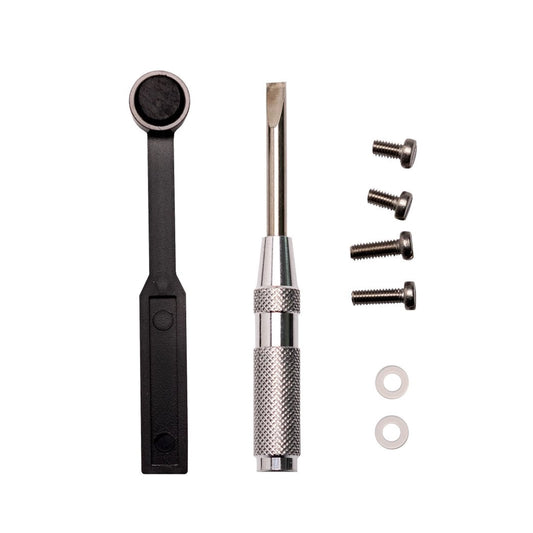
Installation follows the same two-screw mounting method as the rest of the 2M range, fixing the cartridge body directly to the headshell without intermediate spacers. A recommended tracking force of 1.5g gives a starting point for setting downforce on the tonearm, and the dynamic lateral compliance of 22 μm/mN indicates how the cantilever suspension responds to that downforce, which matters when matching the cartridge to a tonearm's effective mass. Pairing a cartridge with too much or too little compliance for a given tonearm can compromise tracking and resonance behaviour, so this figure is worth checking against your tonearm's specification before purchase. The cartridge also has a recommended load capacitance of 150-300pF, which determines how the input capacitance of your phono stage should be set or selected to avoid an unbalanced high-frequency response.
Can you upgrade the stylus later?
Yes. The 2MR Bronze accepts every stylus in the 2M range, giving it full interchangeability across the series from 2M Red through to 2M Black LVB. This means you can start with a lower-tier stylus and later fit a higher-specification one onto the same cartridge body and generator, rather than replacing the entire cartridge to move up the range. For buyers who anticipate upgrading their system over time, this turns the 2MR Bronze into a long-term platform rather than a single fixed-specification purchase, since the body, coil system and mounting stay the same while only the stylus assembly changes.
How does the quad coil system affect sound reproduction?
The 2MR Bronze uses Ortofon's quad-coil generator with split pole pins, a coil and magnetic circuit design exclusive to genuine Ortofon cartridges. Split pole pins alter how the magnetic field is shaped around the coils, which Ortofon developed to improve channel separation and tracking accuracy compared with a conventional single pole-pin layout. The coil wire itself is silver-plated OFC (oxygen-free copper), a conductor choice that affects the cartridge's electrical characteristics and its output voltage, rated at 5mV at 1kHz, 5cm/sec. That output level is a practical compatibility point: it tells you whether your phono stage's gain is suited to a moving magnet input, since MM stages are calibrated for output voltages in this range rather than the much lower output of moving coil cartridges. Tracking ability is rated at 80 μm at 315Hz, indicating the maximum groove modulation the stylus can follow accurately, which is a direct measure of how the generator and suspension cope with heavily modulated or loud passages.
What is the 2MR Bronze cartridge body made from, and what stylus does it use?
The cartridge body combines polymer and aluminium, a construction Ortofon uses to keep the housing rigid while controlling overall mass, which matters because cartridge weight feeds directly into tonearm mass-matching calculations. At 6g, the 2MR Bronze sits within typical mass ranges for medium-mass tonearms commonly fitted to turntables in this category. The stylus is a Nude Fine Line diamond mounted on an aluminium cantilever; a nude-mounted diamond is bonded directly without a metal shank, reducing the moving mass at the stylus tip so the cantilever can respond more precisely to groove modulation. The Fine Line profile itself has a narrower contact area than a conventional elliptical or spherical stylus, allowing it to trace more of the groove wall and recover detail that simpler profiles can miss. The stylus is bronze in colour, distinguishing it visually from other styli in the 2M range when handling or storing multiple cartridges.
Where does the 2MR Bronze sit within Ortofon's range?
The 2MR Bronze occupies a mid-tier position within Ortofon's 2M and 2MR families. Buyers comparing it against the standard-height 2M Bronze are choosing between two electrically similar cartridges with the same Nude Fine Line stylus and quad-coil generator; the deciding factor is turntable clearance, since the 2MR's slimmer housing is intended for decks where the standard 2M body wouldn't otherwise fit. Within the 2MR series itself, the Bronze sits above 2M Red and Blue derivatives and below 2M Black LVB, meaning buyers who want the option to upgrade their stylus later without changing cartridges can do so within the same low-profile housing. Anyone whose turntable already has standard clearance and who has no need for the slimmer profile would have no compatibility reason to choose the 2MR body over the standard 2M, since the housing height reduction is the defining feature that separates the two ranges.