Wharfedale DIAMOND 12.0
The Wharfedale DIAMOND 12.0 is the ultra-compact model in the DIAMOND 12 series, built as a bookshelf speaker for listeners who want the series' driver and cabinet engineering in a footprint suited to small rooms and equipment racks. Wharfedale positions the DIAMOND 12.0 for two distinct buyers: the two-channel hi-fi owner working with limited shelf or stand space, and the home theatre owner who needs a high-performance satellite speaker rather than a full-size floorstander. Both buyers get the same driver technology found across the DIAMOND 12 range, scaled into a 4.4-litre cabinet.
What makes the DIAMOND 12.0's bass driver different from other compact speakers at this price?
The DIAMOND 12.0 is fitted with a 100mm (4") Klarity driver, built from a cone material Wharfedale developed by blending polypropylene with mica. This blend adds stiffness to the cone, which reduces flexing across the driver's operating range. A cone that resists flexing keeps its shape as it moves, so the driver stays lightweight while still producing a controlled, accurate response instead of the smeared or coloured output that flexing causes in less rigid cones. Wharfedale pairs the Klarity cone with a low-damping surround, using ribbing modelled across multiple cone shapes to flatten the driver's response curve. This matters because a high-damping surround is the usual way to tame resonance peaks, but it comes at the cost of dynamic expression; the ribbed, low-damping approach reaches a flat response without that trade-off. The motor system adds an aluminium compensation ring to the magnet assembly, which reduces the way inductance changes as the voice coil moves through its travel. Since inductance shifts are a source of distortion and intermodulation, controlling them at the magnet stage keeps the driver's output cleaner under load. The voice coil itself is wound on an epoxy/glass fibre bobbin, a choice Wharfedale notes is unusual at this price level. Unlike an aluminium bobbin, the epoxy/glass fibre construction doesn't generate eddy currents, so the driver can handle more power without that power being wasted as heat in the bobbin. It's also stiffer than the Kapton bobbins commonly used at this price point, which helps the coil stay accurately positioned in the magnetic gap during high-excursion bass output.
How does its tweeter handle high frequencies?
The DIAMOND 12.0 is equipped with a 25mm (1") woven polyester dome tweeter that carries a high-loss coating. That coating damps unwanted resonance in the dome material itself, which is what lets the tweeter extend smoothly through the top of the audible range rather than developing a peak or ringing as it approaches its limits. Wharfedale has optimised the tweeter's magnet system and front plate for wide dispersion, and the front plate sits flat against the dome rather than recessing it, exposing as much of the dome surface as the design allows. A very short duct on the front plate then balances the acoustic load on the dome and improves the tweeter's sound pressure level measurement, so the wide-dispersion, low-restriction geometry doesn't come at the cost of output.
What crossover design does it use?
The DIAMOND 12.0 is built around an acoustic LKR crossover network with a 24dB slope, using air-core inductors rather than the laminated steel or ferrite core inductors typically found at this price point. Wharfedale selected air-core inductors because they produce the lowest distortion of the available inductor types, a construction more commonly associated with higher-end speakers. Air-core inductors carry higher resistance than laminated steel or ferrite versions, so Wharfedale modified the magnetic structure of the mid/bass driver to compensate for that added resistance. The result is a crossover point that hands off to the bass driver without introducing distortion from the inductor itself, keeping bass response fast and clean through the 2.7kHz crossover frequency.
Will the DIAMOND 12.0 work with my amplifier and system?
The DIAMOND 12.0 is rated at 8Ω nominal impedance, described as compatible with standard amplifier outputs, with a minimum impedance of 4.0Ω that most stereo and AV amplifiers are designed to drive without strain. Sensitivity is 87dB (2.83V @ 1m), and Wharfedale recommends amplifier power between 20W and 60W, which places the DIAMOND 12.0 within the output range of typical integrated amplifiers, AV receivers, and stereo receivers rather than requiring specialist high-power amplification. Frequency response runs from 70Hz to 20kHz (+/-3dB), with bass extension down to 65Hz (-6dB), figures that describe a speaker built to work as a main channel in a compact two-speaker system or as a satellite alongside a subwoofer in a multichannel setup, rather than as a full-range floorstander.
Where does this speaker fit in a small-footprint or home theatre system?
The DIAMOND 12.0 is described by Wharfedale as the ultra-compact speaker in the DIAMOND 12 series, sharing its driver, tweeter, crossover, and cabinet engineering with the larger models in the range while packaging it into a 4.4-litre enclosure. That makes it the model to consider when shelf space, stand footprint, or room size is the deciding factor, or when the application calls for a satellite speaker within a home theatre system rather than a stereo pair carrying full-range duty on its own. Buyers building a compact two-channel system, or a satellite-and-subwoofer layout for home cinema, get the same DIAMOND 12 driver, tweeter, and crossover engineering from the 12.0 as they would from the rest of the range, in the smallest cabinet the series offers.
How is the cabinet built to control resonance?
The DIAMOND 12.0 is built with a bass reflex enclosure, sized so its internal volume works with the drive unit system to produce the intended bass output rather than being left as an arbitrary box size. Wharfedale builds the cabinet from a multi-layered sandwich construction, a design intended to subdue the cabinet's own resonant signature so it colours the drivers' output as little as possible; Wharfedale states it measured the resonant properties of the glue between the layers to find the best-performing combination. Inside the cabinet, Intelligent Spot Bracing connects opposite panel walls using a specific wood brace shape, computer-modelled to reduce cabinet resonance more effectively than a standard "figure of eight" brace, which can simply transfer resonance from one wall to another rather than removing it.
What are the DIAMOND 12.0's dimensions for placement in a small room?
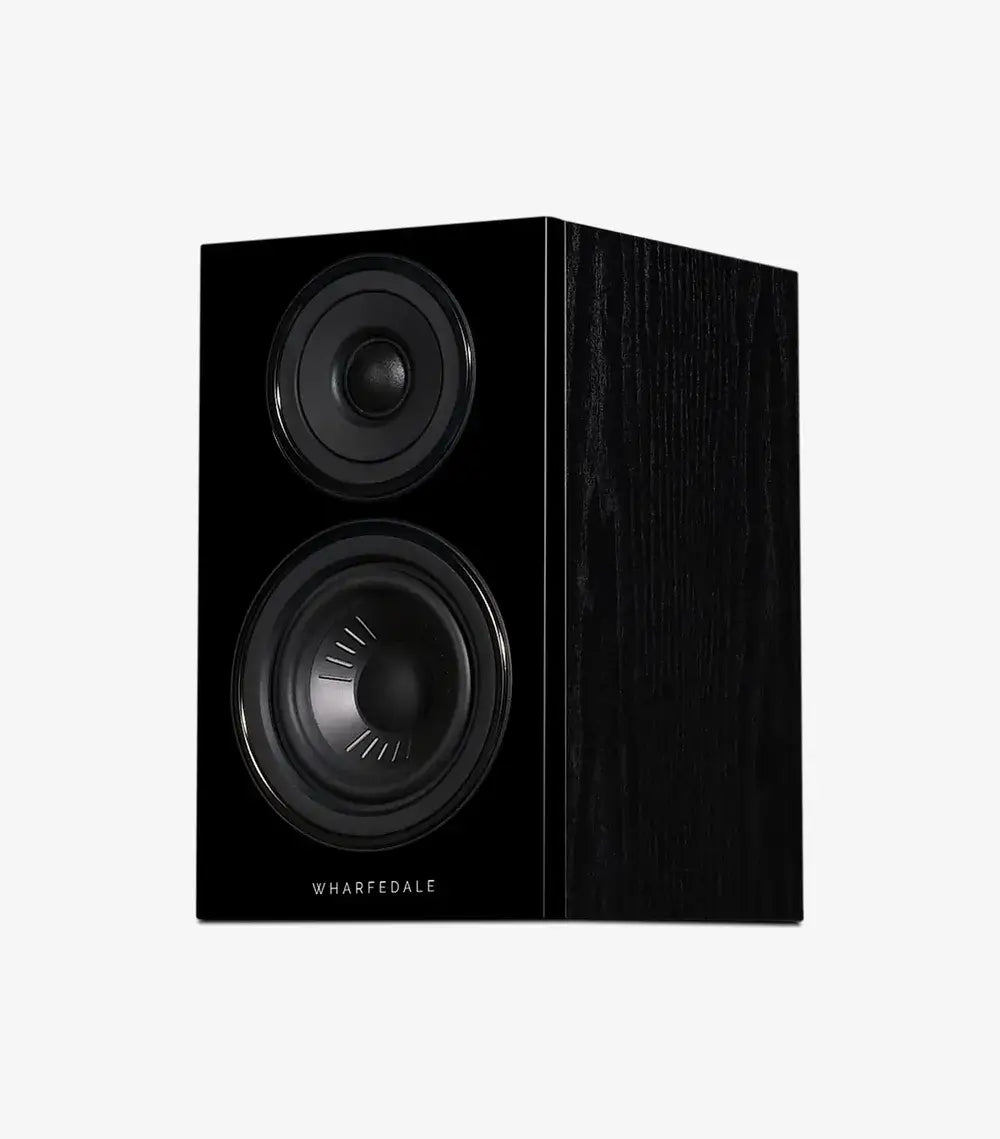
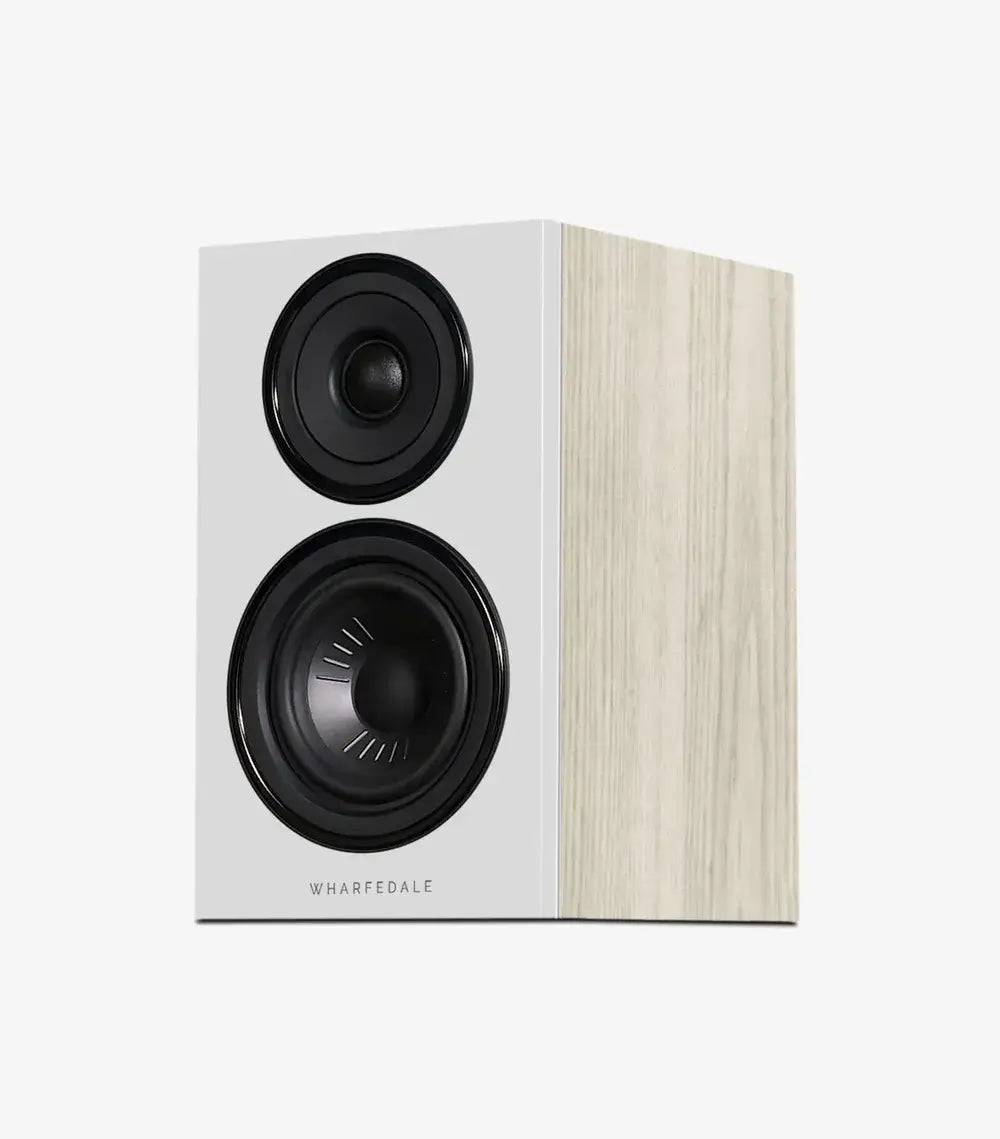
The DIAMOND 12.0 is 265 x 160 x (200+28) mm and weighs 5.1kg per unit, dimensions that support its role as a stand-mount or shelf-mount speaker in rooms where a larger DIAMOND 12 model, or a floorstander, wouldn't fit the available space. The compact bookshelf format suits equipment racks, bookshelves, and speaker stands alike, and its home theatre use as a satellite speaker follows from the same small footprint that makes it practical in a two-channel setup. It's available in Black Oak, Walnut Pearl, Light Oak, and White Oak finishes.