Why the Wharfedale DIAMOND 12.2 suits larger rooms and more powerful 2-channel systems
The Wharfedale DIAMOND 12.2 is a standmount, or bookshelf, speaker built with a larger cabinet volume and driver size than the more compact models in the DIAMOND 12 Series. It's intended for buyers moving up from a smaller standmount format who want more low-frequency extension and output headroom for a larger room, while staying within a 2-way bookshelf design rather than stepping up to a floorstander. The sections below cover what differentiates it, how it matches with an amplifier and system, where it performs best, and who it's built for.
What sets the Wharfedale DIAMOND 12.2 apart from other bookshelf speakers?
The Wharfedale DIAMOND 12.2 is built around a 150mm (6.5") Klarity cone, a bass driver material formulated from a blend of polypropylene and mica. This blend adds stiffness to the cone without adding weight, so the driver flexes less as it moves and keeps its shape at higher output levels. The result is a lightweight cone with high rigidity, low colouration and a fast response to transient signal changes. A low-damping surround pairs with the cone, and Wharfedale reached this combination by simulating multiple cone shapes and adding ribs for extra stiffening, achieving a flat response curve without needing a high-damping surround that would otherwise slow the driver down.
The magnet system uses an aluminium compensation ring to minimise variation in inductance as the voice coil travels back and forth. This keeps the motor's magnetic behaviour consistent across the full excursion of the driver, reducing distortion and intermodulation that would otherwise be generated by the motor system itself. The voice coil is wound on a high-power epoxy/glass fibre bobbin, a construction more commonly found in speakers well above this price point. Unlike an aluminium bobbin, this material doesn't generate eddy currents, so it delivers greater power handling, and it holds its shape more rigidly under load than the Kapton bobbins typically used in this price class.
Which amplifiers and systems will it pair with?
The DIAMOND 12.2 is rated at a nominal impedance of 8Ω compatible, with a minimum impedance of 4.0Ω, so it works with the wide range of amplifiers designed around an 8Ω nominal load. Sensitivity is rated at 88dB (2.83V @ 1m), and Wharfedale recommends amplifier power between 20W and 120W, giving buyers a working range for matching amplifier output to the speaker rather than needing to hit an exact figure. Peak SPL is rated at 96dB, indicating the maximum output the driver and crossover combination can handle before compression or damage becomes a risk. Frequency response is quoted at 50Hz to 20kHz (+/-3dB), with bass extension reaching 43Hz at the -6dB point, so buyers building a 2-channel system around this speaker get a useful indication of how low it will reach without a subwoofer.
Where does it perform best?
The DIAMOND 12.2 is a rear-ported, bass reflex design, meaning the cabinet uses a tuned port at the back to reinforce low-frequency output. The enclosure has a cabinet volume of 11.8 litres, sized specifically to work in harmony with the 150mm driver and deliver the intended bass response, so the internal volume isn't incidental but part of the tuning. Because the port fires from the rear, the speaker needs clearance behind it to load correctly, which buyers should factor into placement against a wall or on a stand. Wharfedale positions this model for larger rooms and more powerful 2-channel hi-fi systems, reflecting the increased cabinet volume and driver size compared with smaller standmount models in the range.
Who should choose the Wharfedale DIAMOND 12.2 for a 2-channel hi-fi system?
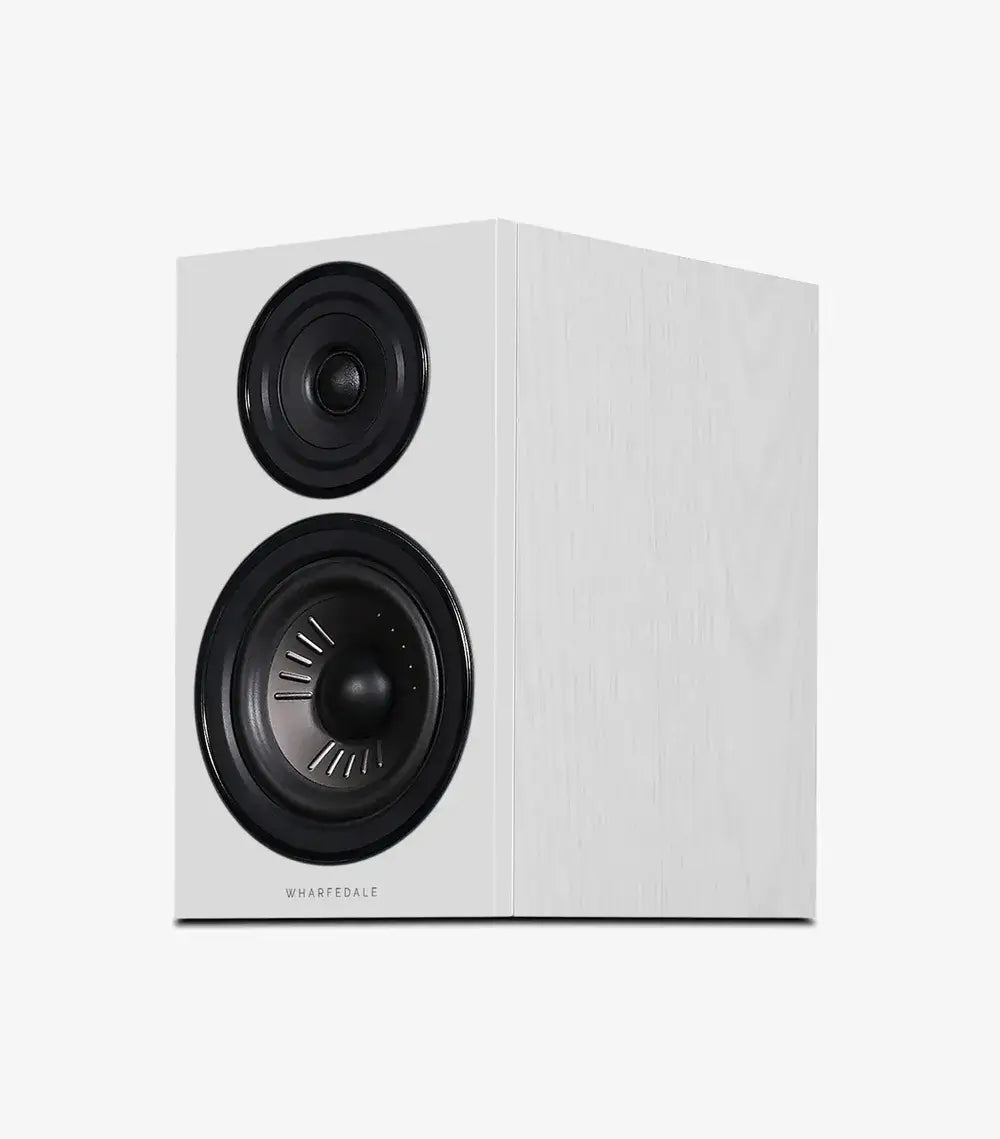
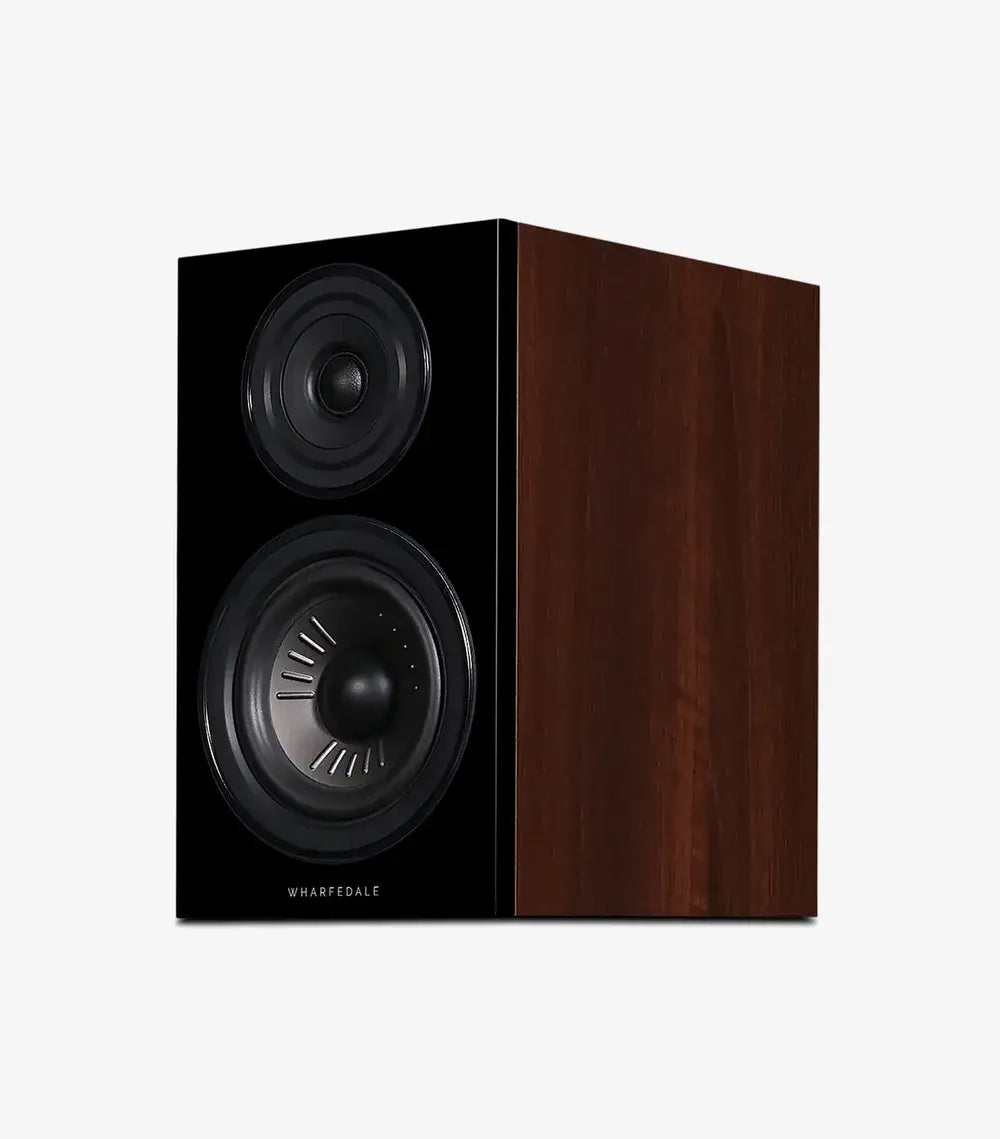
The Wharfedale DIAMOND 12.2 is aimed at buyers who want more from a traditional standmount or bookshelf speaker format than a compact model can offer, without stepping up to a floorstander. It suits owners building or upgrading a 2-channel hi-fi system in a larger room, where the increased cabinet volume and 150mm driver support higher output and deeper bass extension than a smaller-volume bookshelf speaker in the same series. Dimensions are 335 x 200 x (285+28)mm and net weight is 8.2kg per unit, both relevant to buyers checking stand or shelf load capacity and available space before committing to the larger format. The speaker is available in Black Oak, Light Oak, Walnut Pearl and White Oak finishes, giving buyers a choice to match different room settings.
How does the tweeter shape the high-frequency output?
The DIAMOND 12.2 is fitted with a 25mm (1") dome tweeter made from a woven polyester film with a high-loss coating, a construction chosen to deliver open, smoothly extended high frequencies rather than a peaky or harsh top end. The magnet system and front plate around the dome have been optimised for wide dispersion and to avoid compressed behaviour at higher output. The front plate itself is kept flat and exposes the dome as much as the design allows, with only a short duct included to balance the acoustic load and improve the SPL measurement. Crossover frequency between the bass driver and tweeter sits at 2.0kHz, marking the point at which output responsibility shifts from the 150mm cone to the dome tweeter.
What crossover design does the speaker use?
The DIAMOND 12.2 is equipped with an acoustic LKR 24dB crossover topology, built with air-core inductors, a component type more commonly found in higher-end speakers because it produces lower distortion than other inductor types. Air-core inductors carry higher resistance than a standard laminated steel or ferrite core inductor, so Wharfedale modified the magnetic structure of the mid/bass driver to compensate for that resistance. This combination is intended to deliver fast, clean bass without distortion introduced by the inductor itself, linking the crossover design directly to the bass performance described above.
How is the cabinet engineered to control resonance?
The DIAMOND 12.2 is built internally with Intelligent Spot Bracing, connecting opposite cabinet walls with a specifically shaped wood brace rather than a generic support. These braces were modelled by computer simulation to improve on the commonplace figure-of-eight brace, which can simply transfer resonance from one wall to another instead of reducing it. The cabinet itself uses a multi-layered sandwich construction intended to subdue the cabinet's own identifiable resonant signature, and Wharfedale measured the resonant properties of the glue used between the layers to determine the combination that best controls unwanted cabinet sound. Together, the bracing and the sandwich panel construction address cabinet resonance from two directions: wall-to-wall energy transfer and the resonant behaviour of the panel material itself.
Where does the DIAMOND 12.2 sit within Wharfedale's range?
The DIAMOND 12.2 is part of the Wharfedale DIAMOND 12 Series, positioned as the larger-volume bookshelf option within that series rather than the standard standmount size. Buyers comparing it against smaller DIAMOND 12 models should weigh the larger cabinet volume, bigger 150mm driver and correspondingly larger footprint and weight against the more compact dimensions of a standard standmount speaker. It's intended for buyers whose room size and system power can make use of the extra cabinet volume and driver area, rather than those prioritising the smallest possible footprint for near-field or shelf placement.