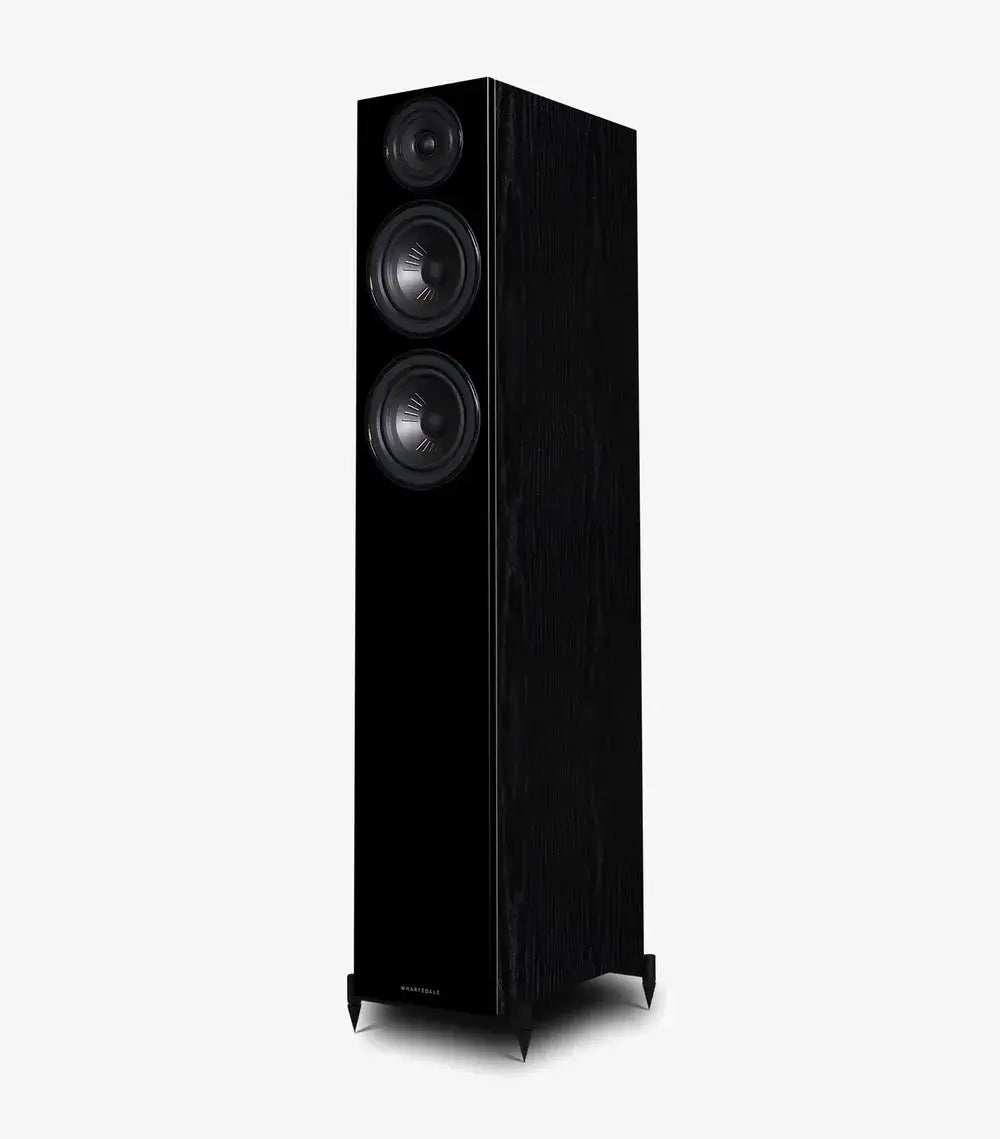
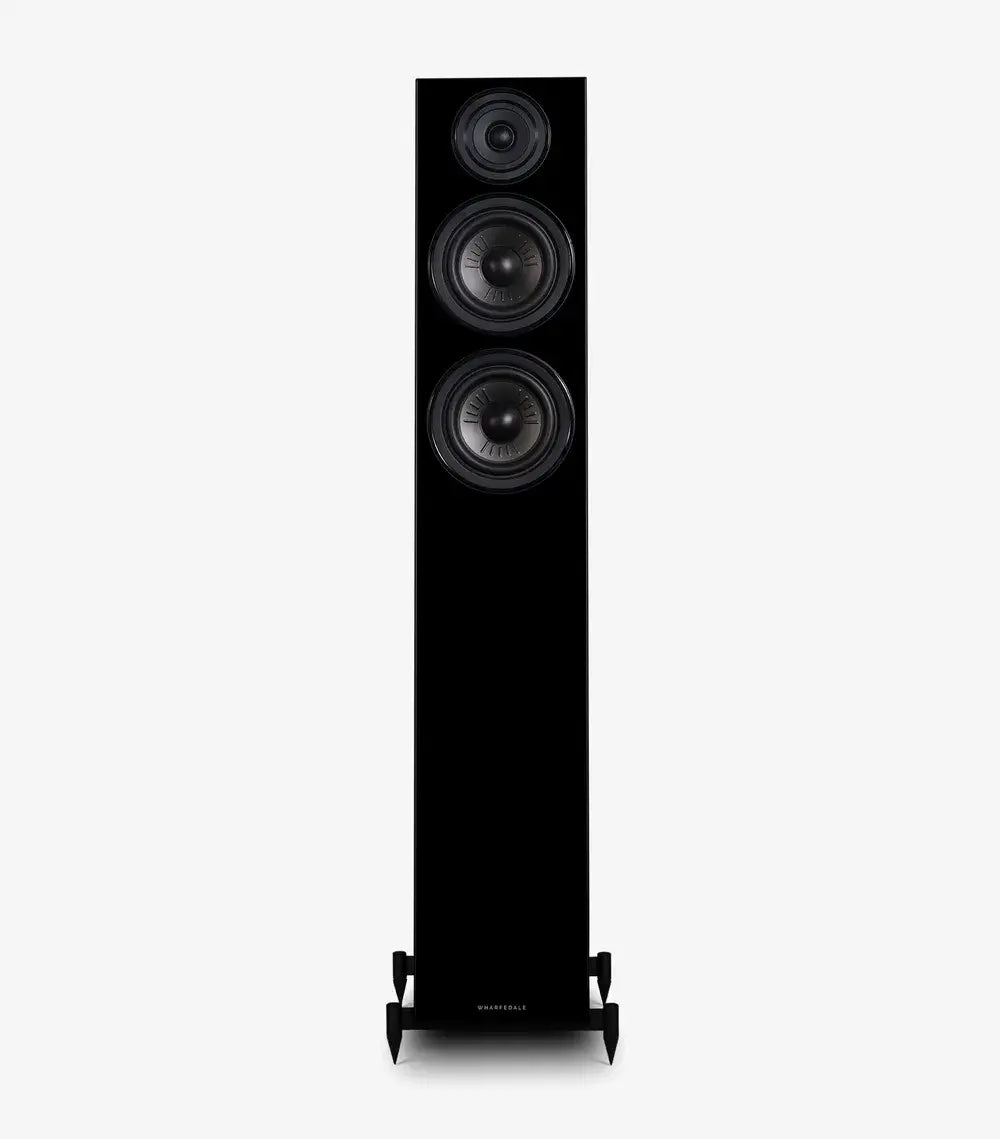
Wharfedale DIAMOND 12.4 Floorstanding Speakers: the powerhouse of the DIAMOND 12 range
The Wharfedale DIAMOND 12.4 Floorstanding Speakers are the largest and most powerful model in the DIAMOND 12 series, built for buyers who want a room-filling, chest-pounding output rather than a compact stereo pairing. Wharfedale positions this model for larger, more powerful systems and cinema-style home theatre setups, where a single pair of speakers needs to deliver an impactful, immersive performance across a bigger listening space. This is a 2.5-way floorstanding speaker, a configuration that separates it from smaller two-way models in the range and shapes most of the buying decisions that follow, from amplifier matching to placement.
What makes the DIAMOND 12.4 different from other models in the DIAMOND 12 series?
The DIAMOND 12.4 is configured as a 2.5-way system with dual 150mm (6.5-inch) Klarity cone drivers handling mid-range and bass duties, paired with a single 25mm (1-inch) dome tweeter for the high frequencies. Running two mid/bass drivers rather than one, as smaller DIAMOND 12 models do, gives it a larger radiating surface area and a bigger internal cabinet volume of 40.8 litres, which together support a bass extension down to 35Hz (-6dB) and a peak SPL of 102dB. Buyers choosing between
DIAMOND 12 models should treat cabinet size and driver count as the main differentiator: this model trades a smaller footprint for the low-frequency extension and headroom that larger rooms and home cinema use demand.
Which amplifiers and systems is this speaker compatible with?
This model's nominal impedance is rated as 8Ω compatible, with a minimum impedance of 5.0Ω and a sensitivity of 89dB (2.83V at 1m). Wharfedale recommends amplifier power between 30W and 200W, which puts it within reach of a wide range of AV receivers and stereo amplifiers rather than requiring a specialist high-current design. Because the minimum impedance dips to 5.0Ω rather than staying at a flat 8Ω, it's worth checking that an amplifier is comfortable driving a moderately reactive load, particularly in multichannel home cinema systems where several speakers are run from the same unit. There's no AV shield fitted, which is a relevant compatibility point for anyone positioning the speaker close to a CRT display or similarly magnetically sensitive equipment, though this is largely a legacy consideration with modern flat-panel screens.
How does the cabinet's 2.5-way configuration affect placement and setup?
The enclosure is rear-ported, so it needs clearance behind the cabinet to let the port work correctly and to avoid boundary reinforcement that can overload the bass. Wharfedale states that the internal cabinet volume has been precisely sized to work in harmony with the drive unit system, meaning the port tuning and cabinet size are matched specifically to the dual 150mm driver arrangement rather than adapted from a smaller enclosure. With a frequency response of 40Hz to 20kHz (+/-3dB) and a crossover point at 2.1kHz, it's designed to be set up as a full-range front or main channel speaker, and its dimensions of roughly 1100mm high by 200mm wide by 350mm deep mean buyers need to plan floor space accordingly before installation.
Who should choose the Wharfedale
DIAMOND 12.4 over a smaller
DIAMOND 12 model?
The DIAMOND 12.4 suits buyers assembling a system for a larger room, or building a cinema-style front stage where the main speakers need to carry both dialogue-adjacent mid-range and deep bass without support from a subwoofer. Anyone working with a smaller listening room, or wanting a more compact floorstander for a two-channel system, is better served by a smaller model within the range, since this speaker's larger cabinet and dual driver layout are built specifically around extension and output rather than a small-room footprint. It sits within Wharfedale's DIAMOND 12 Series Floorstanding Speakers line-up, and buyers already invested in DIAMOND 12 electronics or matching centre and surround models can extend that system upward with the 12.4 for the front channels.
How does the Klarity cone improve mid-range and bass performance?
The mid/bass drivers use Wharfedale's Klarity cone material, a blend of polypropylene and mica that adds stiffness to the cone and reduces flexing. This stiffness lets the driver stay lightweight while resisting the cone break-up that causes colouration and slows a driver's response, which is why Wharfedale can pair a low-damping surround with the Klarity cone rather than relying on a high-damping surround to control resonance. Ribbing and cone-shape simulation were used to flatten the response curve, so the low colouration benefit of the low-damping surround doesn't come at the cost of an uneven frequency response. Behind the cone, a precision-made magnet system uses an aluminium compensation ring to minimise the effect of inductance variation as the voice coil travels, cutting distortion and intermodulation generated by the motor system itself. The voice coil is wound on a high-power epoxy/glass fibre bobbin, a construction more commonly found above this price point, which avoids the eddy currents associated with aluminium bobbins and handles more power than the Kapton bobbins typically used in this class.
What gives the tweeter its extended high-frequency performance?
The 25mm dome tweeter is made from a woven polyester film with a high-loss coating, a construction chosen to deliver open, smoothly extended high frequencies. Wharfedale has optimised the magnet system and front plate for wide dispersion and uncompressed behaviour, and the front plate itself is kept flat to expose as much of the dome as possible, which widens the tweeter's dispersion pattern. A short duct on the front plate balances the acoustic load on the dome and improves the SPL measurement, a detail that matters for buyers pairing this speaker with other DIAMOND 12 models, since consistent tweeter behaviour across the range supports matched tonal balance between front, centre, and surround channels.
How does the crossover network affect bass clarity?
The crossover network is built around an acoustic LKR 24dB topology and uses air-core inductors, a component type more commonly found in higher-end speakers and selected because it produces less distortion than laminated steel or ferrite core inductors. Air-core inductors carry higher coil resistance than steel or ferrite alternatives, so Wharfedale modified the mid/bass driver's magnetic structure to compensate for that resistance, keeping bass output fast and clean without the distortion an uncompensated air-core inductor could introduce. It's a direct engineering trade-off buyers benefit from without needing to adjust anything themselves: the crossover choice and the driver's magnetic design were matched during development rather than left for the installer to tune.
Why does cabinet construction matter for sound quality in the DIAMOND 12.4?
The cabinet uses a multi-layered sandwich design intended to subdue the enclosure's own resonant signature, and Wharfedale measured the resonant properties of the glue used between the layers to work out the best combination for damping unwanted vibration. Inside, Intelligent Spot Bracing connects opposite cabinet walls using a specific wood brace form, modelled by computer simulation to reduce cabinet resonance more effectively than a standard figure-of-eight brace, which can simply transfer resonance from one wall to another rather than eliminating it. For a buyer, this construction approach means the enclosure is engineered to stay acoustically neutral at the volume levels the dual drivers and this model's peak output are capable of producing, rather than adding its own colouration as output increases.