Why Choose the Wharfedale EVO 5.1 Bookshelf Speakers
The Wharfedale EVO 5.1 is a two-way bookshelf speaker built for listeners who want detail and clarity from a compact stand-mount cabinet without stepping up to a floorstanding system. It sits within Wharfedale's EVO 5 Series, a successor to the multi-award-winning EVO4 range, and carries forward the same research base as Wharfedale's flagship Elysian project. That shared development lineage is the reason the EVO 5.1 is positioned as a speaker that closes the gap between affordable stand-mounts and higher-end audio equipment, rather than as a simple update of its predecessor.
What makes the EVO 5.1 Bookshelf Speakers different from other stand-mounts?
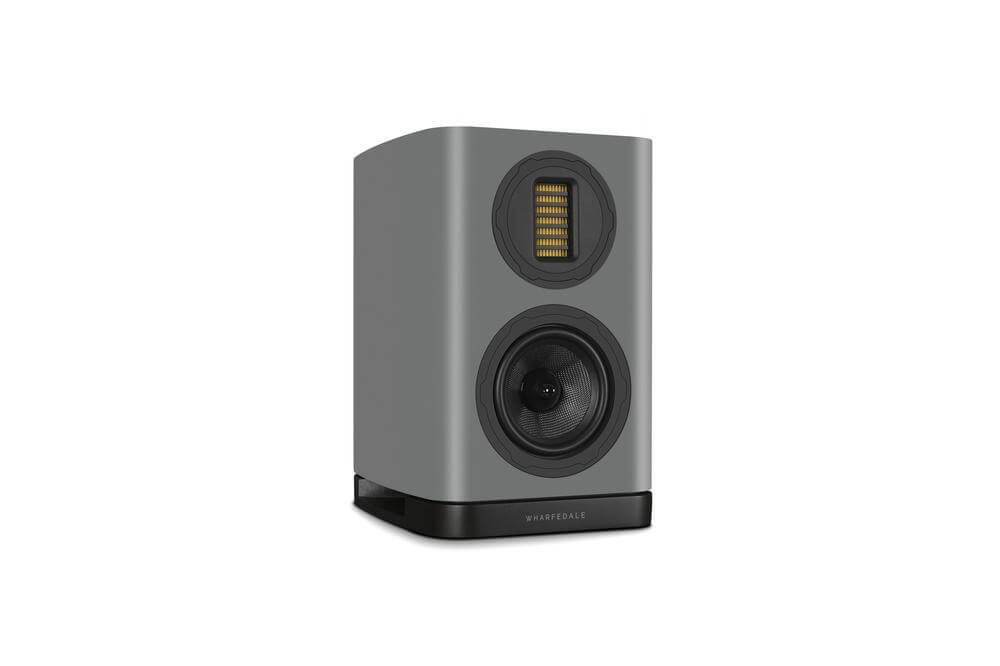
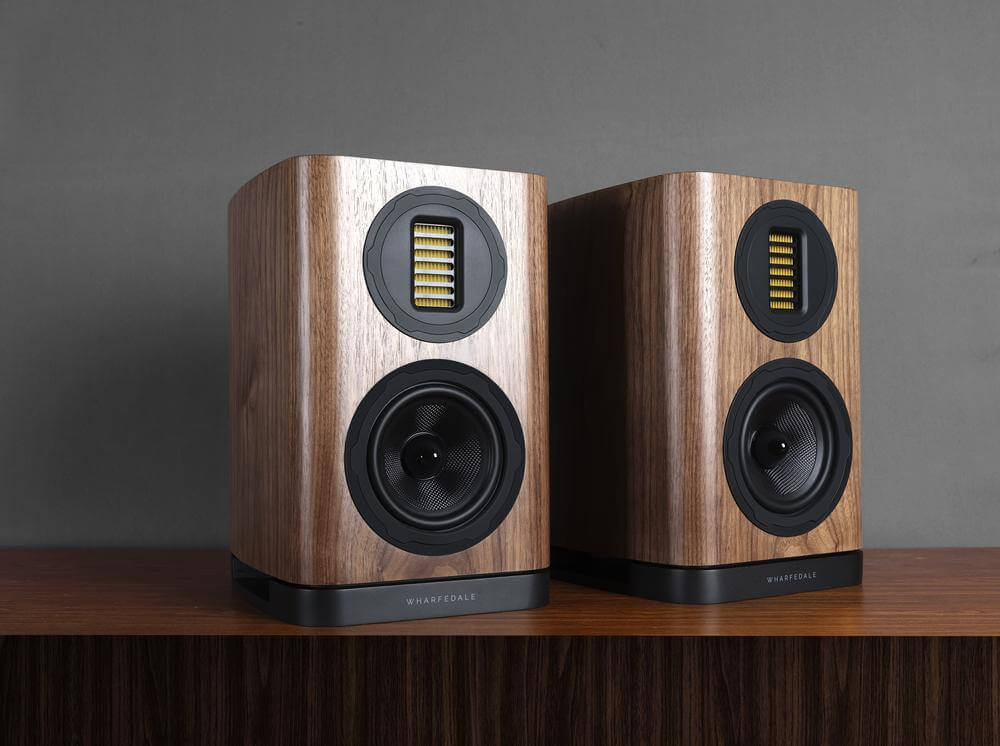
The EVO 5.1 is distinguished by its Air Motion Transformer (AMT) tweeter, a high-frequency driver that replaces the dome or cone found in typical bookshelf speakers. Instead of pushing air forward with a moving dome, the 35 x 70mm AMT uses a pleated diaphragm made from an ultra-thin polymer film, held between magnets on either side. When the diaphragm is energised, the pleats contract and expand, squeezing air out in a controlled motion. Because this folded design displaces up to four times more air than a dome tweeter of equivalent surface area, the driver can move less to produce the same output. That reduced excursion is what lowers distortion, sharpens transient response, and extends both frequency range and dispersion compared with a conventional dome unit. In the EVO 5 Series, Wharfedale has further enlarged the AMT's radiating area and redesigned its frontplate specifically to improve directivity, meaning the treble stays more consistent as a listener moves off the direct listening axis. For a buyer comparing tweeter technologies at this price point, the AMT is the main reason the EVO 5.1 targets a higher-fidelity outcome than its category peers.
Which amplifiers and systems suit it?
The EVO 5.1 is rated at a nominal impedance of 4Ω, though Wharfedale specifies it as 8Ω compatible, so it will pair with amplifiers designed around either standard, provided they can sustain a minimum impedance of 3.4Ω. Wharfedale recommends amplifier power between 25W and 100W, giving buyers a working range for matching integrated amplifiers or AV receivers without under- or over-driving the drivers. Sensitivity is rated at 87dB (2.83V @ 1m), a figure that determines how much amplifier power is needed to reach a given volume in a given room; buyers with lower-powered amplifiers should weigh this alongside the peak SPL rating of 98dB, which indicates the maximum output the speaker can handle before clipping becomes audible. Frequency response is quoted at 56Hz to 24kHz (+/-3dB), with bass extension reaching 46Hz (-6dB), so the EVO 5.1 will handle most music without a subwoofer, though owners seeking deeper low-frequency extension may still choose to add one.
How should it be installed and positioned?
The EVO 5.1 is fitted with rubber feet as standard, which decouple the cabinet from a shelf or stand surface and reduce the transfer of vibration into the supporting furniture. Wharfedale offers purpose-built stands for the EVO 5.1 and EVO 5.2 models, constructed from high-carbon steel and engineered to position the speakers at typical seated listening height while minimising vibration and interaction with the floor, both of which can otherwise colour the sound reaching the listener. Because the EVO 5.1 uses a bass reflex enclosure, installation should allow some clearance from rear walls; a ported design of this kind is more sensitive to boundary placement than a sealed cabinet, since nearby surfaces can reinforce or muddy the bass output.
Who is the Wharfedale EVO 5.1 Bookshelf Speakers designed for?
The EVO 5.1 is aimed at two overlapping groups of buyers: audiophiles seeking nuanced musical expression from a modestly sized cabinet, and casual listeners who want clarity and depth without managing a larger floorstanding system. Its compact dimensions of 340mm (on plinth) by 220mm make it suited to shelf placement or stand mounting in rooms where a floorstander would be impractical, while the engineering carried over from the Elysian project is intended to give it a performance ceiling above typical speakers of this size and price.
How does internal damping affect its sound?
The EVO 5.1 is built with two proprietary damping technologies that control resonance inside the cabinet and drivers. Silentweave™, a blend of cotton and felt fibre, sits in the cavity behind the AMT diaphragm to reduce sound wave reflection and internal colouration, and the same material has been added to the rear chamber of the midrange unit for the same reason. ResoFrame™, an elastomer damping ring fitted to the front plate of all drive units and visible as a cog-shaped element on the driver's front panel, dissipates resonances in the front plate that would otherwise add distortion and colouration to the speaker's output; on the AMT specifically, an additional elastomer gasket between the diaphragm and front plate further smooths the response in the lower treble band. These two treatments reduce unwanted colouration reaching the listener, which is the mechanism behind the smoother, less harsh treble that Wharfedale associates with the EVO 5 Series.
What has changed in its midrange and bass driver?
The EVO 5.1 is equipped with a 5-inch (130mm) black woven Kevlar bass driver that carries Wharfedale's Resoseal™ treatment, a thin elastomer mass ring applied where the rear of the cone meets the surround. This mass-damping absorbs reflections at that junction that would otherwise disturb the driver's natural roll-off beyond the crossover frequency, keeping that roll-off predictable and consistent rather than irregular as output falls away toward the crossover point.
How does the crossover design affect its imaging and soundstage?
The EVO 5.1 is built around a crossover network developed alongside two years of research into loudspeaker Directivity Index (DI), the measure of how a speaker's off-axis output compares with its on-axis output. Wharfedale used this research to bring the EVO 5.1's off-axis response closer into line with its direct sound, which is what allows the speaker to sound consistent as a listener's ears pick up reflected as well as direct sound in a normal room; the practical result is lower colouration and a more expansive, natural soundstage rather than a narrow, forward-facing sweet spot. The predictable roll-off delivered by the bass/midrange driver's Resoseal™ treatment fed directly into this work: with less unwanted reflection to filter out, Wharfedale simplified the crossover network and tuned a more accurate phase blend into the upper midrange and treble. The crossover's components were also upgraded to audiophile-grade polypropylene capacitors and air-cored coils in the midrange and treble filters, with new circuit board layouts designed for a straight-through signal path from the input terminals to the drive units.
What is its cabinet construction, and why does it matter?
The EVO 5.1 is built on a hybrid plinth that combines metal and wood elements at the base of the cabinet, a construction method chosen to increase structural rigidity and reduce cabinet vibration. A speaker enclosure that flexes or resonates under driver movement adds its own sound to the output, so tightening the base structure is what keeps the EVO 5.1's output free of external resonance artefacts. Internal cabinet volume has also been increased, to 11.5 litres, a change that extends bass response and improves dispersion by giving the reflex port more air to work with. The enclosure is a bass reflex (ported) design rather than a sealed one, using Wharfedale's Slot Loaded Profile Port (SLPP) system, which vents in three directions to the sides and rear of the plinth; SLPP transfers the high-pressure output at the port opening into the room's lower ambient pressure more efficiently, which is the configuration behind the EVO 5.1's extended low-frequency reach, increasing bass power by up to 1.5dB and reducing distortion. The EVO 5.1 is available in matt black, matt white, walnut veneer and matt Lunar Grey finishes, giving buyers a choice of cabinet colour to match different room settings alongside the standard rubber-foot fitting or optional stand.
How does the Wharfedale EVO 5.1 Bookshelf Speakers compare with other speakers in Wharfedale's range?
The EVO 5.1 is Wharfedale's mid-tier bookshelf option, replacing the EVO4 generation and carrying forward that range's reputation while adding the AMT tweeter, Silentweave™, ResoFrame™, and Resoseal™ refinements developed alongside the flagship Elysian Series. Buyers comparing it against the EVO4 are choosing a speaker with a redesigned high-frequency driver and additional internal damping aimed at reducing colouration further than the previous generation achieved. Buyers comparing it against Wharfedale's Elysian Series are choosing a more accessible entry point into the same research lineage, in a smaller stand-mount format rather than the flagship's high-end positioning. For anyone assembling a compact two-channel or stereo system who wants AMT tweeter performance and Elysian-derived engineering without moving to floorstanding speakers or the Elysian range itself, the EVO 5.1 is the model built for that brief.