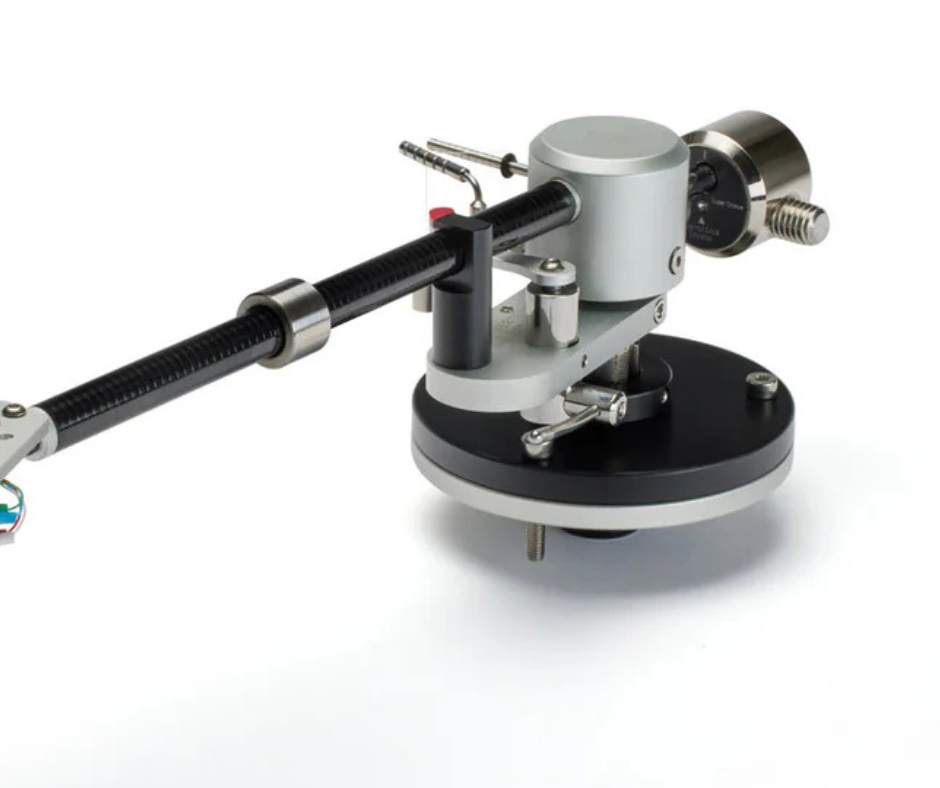
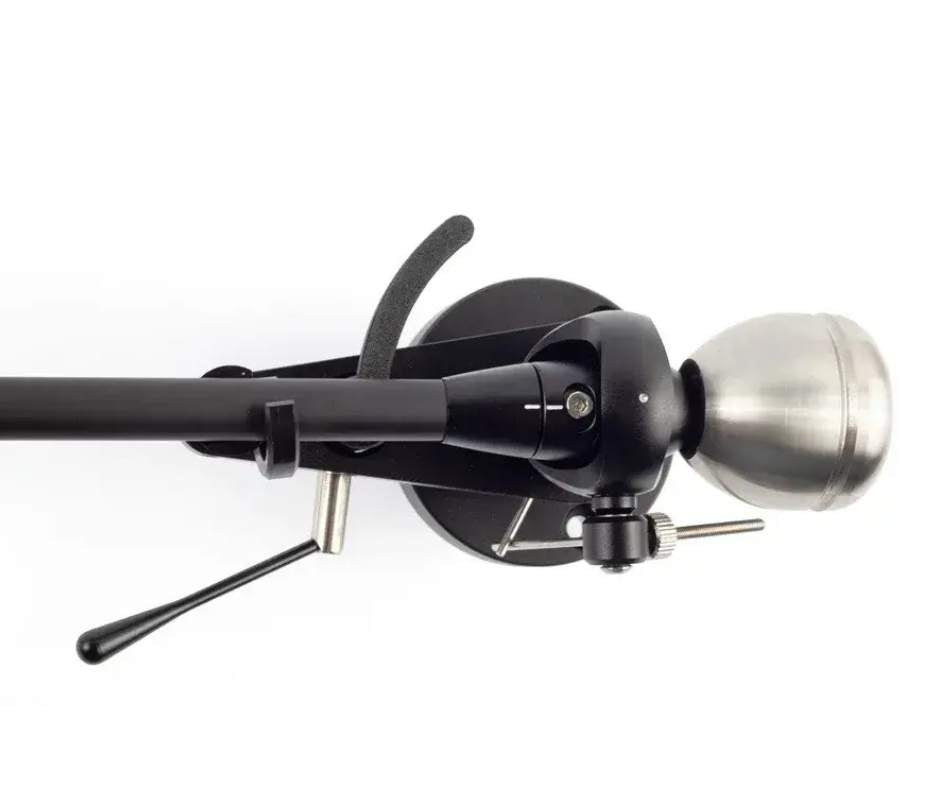
Tonearm geometry describes the mechanical measurements that define effective length, overhang and offset angle, shaping the stylus path across the record and influencing tracking accuracy, channel balance and distortion. Understanding what a tonearm is helps explain why these geometric relationships are fundamental to high-quality analogue playback. These geometric parameters ensure the stylus follows the groove with the correct orientation, minimising tracing error, preserving channel balance and maintaining clean, natural sound reproduction.
Why Tonearm Geometry Matters
Vinyl playback is inherently geometric: a stylus moves along an arc while the record groove spirals toward the centre. Because these paths are not identical, the tonearm must be engineered with precise geometry to minimise angular tracking error. Good geometry reduces distortion, sibilance, mistracking, groove wear and channel imbalance.
1. Effective Length
Effective length is the distance from the tonearm’s pivot point to the stylus tip. It is one of the most fundamental measurements in analogue playback because it defines the arc the stylus will trace.
How Effective Length Works
- The tonearm rotates around a fixed pivot.
- The stylus follows the curved path determined by the arm’s effective length.
- The arc must be optimised to reduce lateral tracking error.
Longer effective lengths (e.g., 12-inch arms) reduce tracking error and distortion but increase mass and require larger turntables. Shorter effective lengths (e.g., 9-inch arms) improve rigidity and reduce resonance but create more angular error.
2. Overhang
Overhang is the distance between the stylus and the centre spindle when the tonearm is positioned directly above the spindle. It represents how far “forward” the stylus extends beyond the pivot-to-spindle line.
Why Overhang Is Critical
Overhang allows the stylus arc to cross two points on the record—called null points—where tracking error is effectively zero. These points help optimise playback across the full playing surface.
Effects of Incorrect Overhang
- Too much overhang → inner-groove distortion, exaggerated sibilance
- Too little overhang → outer-groove distortion, skewed imaging
- Both errors → uneven frequency response and tracking instability
3. Offset Angle
Offset angle is the inward angle at which the headshell or arm tube positions the cartridge relative to the tonearm pivot. This angle helps align the stylus with the record groove, compensating for the circular arc traced by the tonearm.
Why Offset Angle Matters
The record groove is cut in a straight line from the outer edge to the inner radius, but the tonearm tracks in an arc. Offset angle reduces the mismatch between these two motion paths.
Incorrect Offset Angle Causes
- Asymmetrical groove contact left vs right channels
- Sibilance and distortion especially near the inner grooves
- Poor tracking during dynamic passages
- Narrow or unfocused soundstage
Null Points and Alignment Curves
Tonearm geometry aims to achieve minimal tracking error at two null points on the record. These points depend on the chosen alignment curve:
- Baerwald (Löfgren A) — balanced distortion across the record
- Löfgren B — lowest distortion in the mid-groove region
- Stevenson — optimised for inner grooves and classical music
Each geometry has its own distortion characteristics, and enthusiasts choose based on system goals.
How the Three Measurements Work Together
Effective length, overhang and offset angle form a unified geometric system. Changing one parameter alters the others. Proper setup ensures the stylus maintains the correct vertical tracking angle (VTA), stylus rake angle (SRA) and azimuth.
Combined Effects
- Smoother frequency response
- Reduced distortion across the record
- More stable imaging with better channel separation
- Cleaner inner-groove performance
- Greater stylus longevity due to even wear
Common Tonearm Geometry Mistakes
- Setting effective length without adjusting overhang
- Aligning the cartridge square to the headshell instead of the grid
- Using the wrong alignment standard for the tonearm’s design
- Ignoring offset angle and focusing only on VTA
- Assuming the factory setting is correct
Even slight misalignment—fractions of a millimetre—can produce audible distortion or tracking instability.
Explore our range of tonearms designed for stable tracking and precise cartridge control.
Final Thoughts
Tonearm geometry is one of the most important foundations of vinyl playback. Effective length shapes the arc, overhang determines null-point accuracy and offset angle optimises groove alignment. When these geometric elements are correctly configured, the stylus follows the groove with precision, revealing cleaner transients, wider soundstage depth and more expressive musical detail. Accurate geometry is therefore essential for high-performance analogue listening.