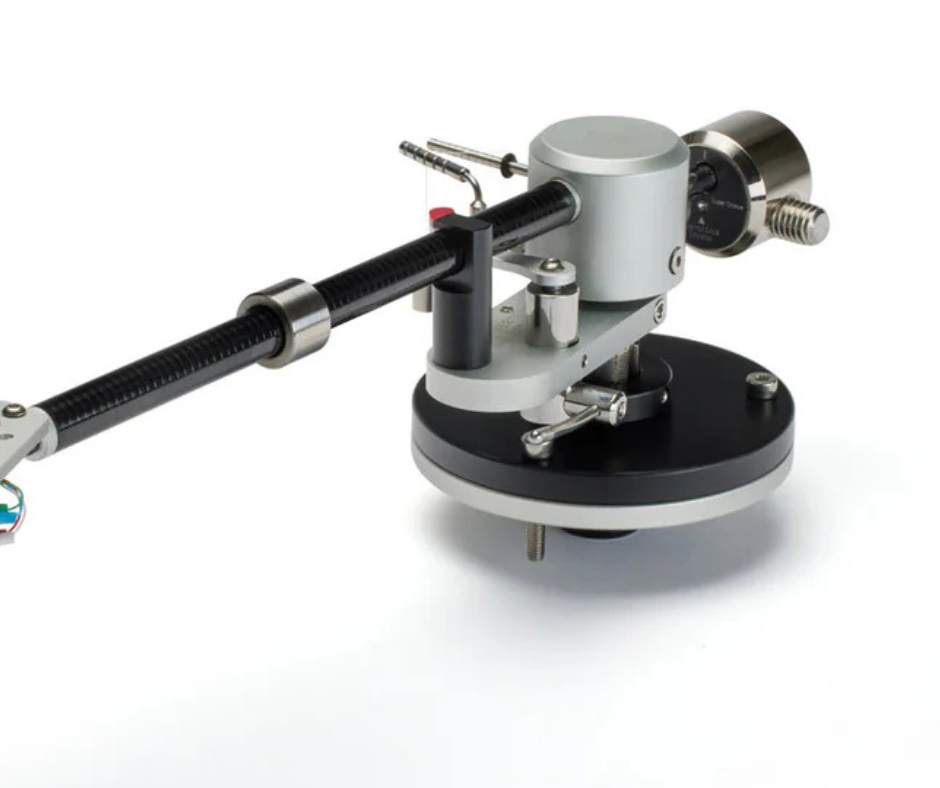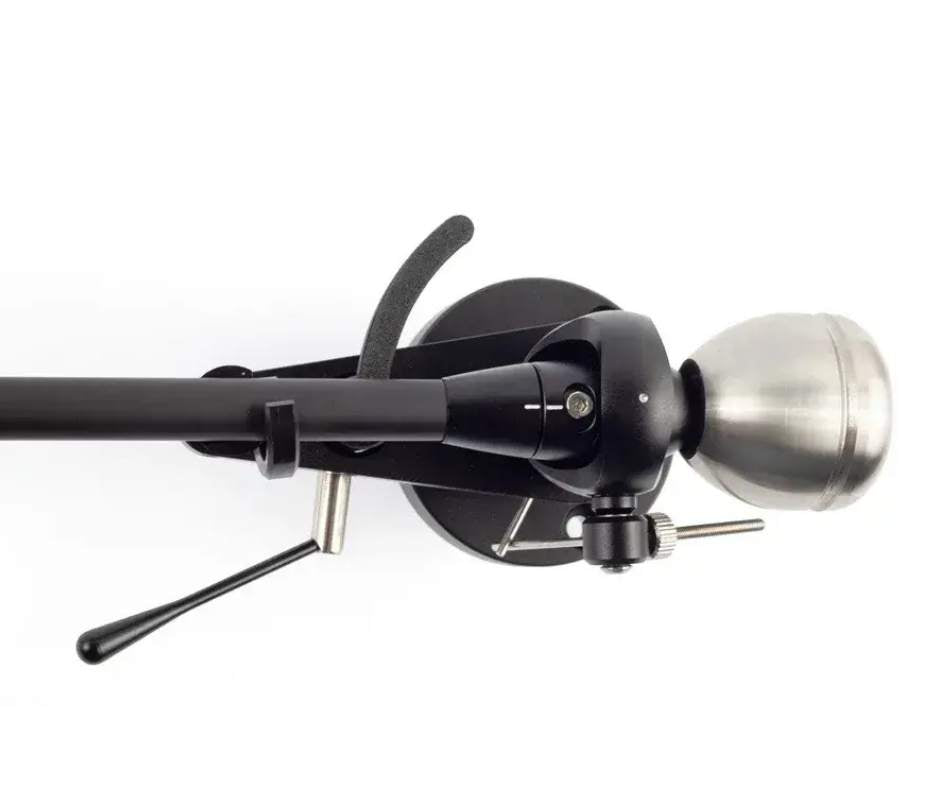
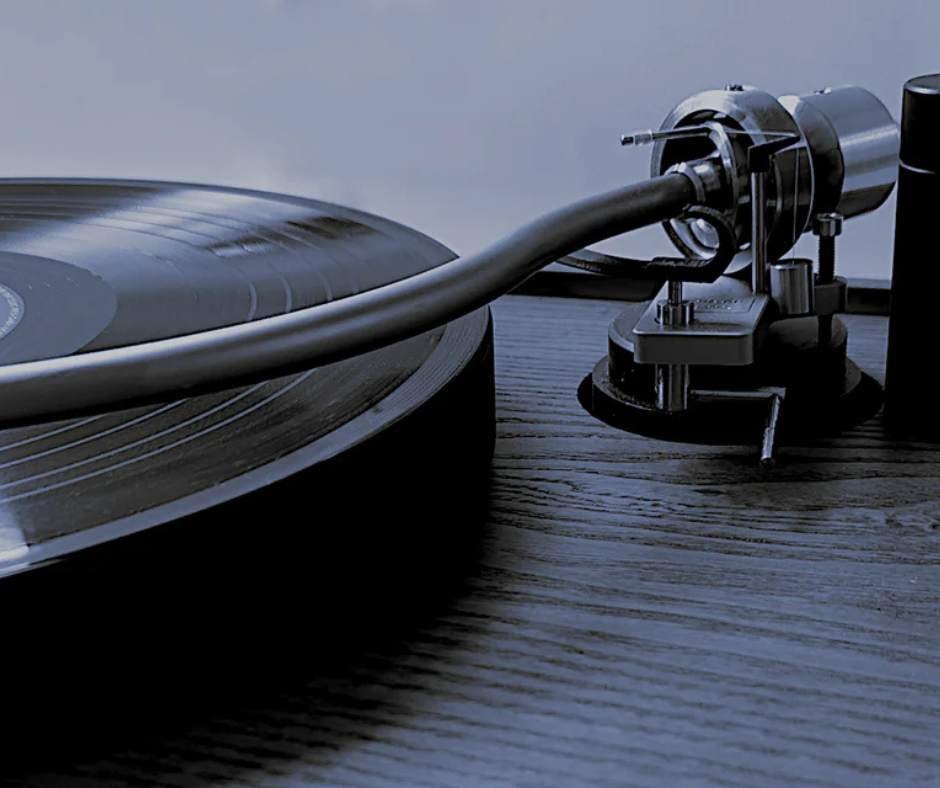
A tonearm is the part of a turntable that holds the cartridge and stylus and guides them across the record as it plays. Its job is to keep the stylus aligned, stable, and correctly weighted so it can accurately follow the record groove from start to finish without damaging the vinyl or introducing distortion.
To do this, a tonearm controls movement, balance, and vibration. It uses precision bearings to move smoothly, a counterweight to set tracking force, and carefully chosen materials to manage resonance. Because the tonearm directly affects how well the stylus tracks the groove, it plays a major role in sound quality, influencing clarity, stereo imaging, bass control, and overall musical accuracy.
If you're looking to compare real-world tonearm designs rather than simply understand how they work, browse our collection of tonearms.
The Core Function of a Tonearm
A tonearm’s primary role is to support the cartridge and allow it to follow the spiral groove at the correct orientation, weight and geometry. To do this, it must:
- Maintain fixed geometry across the record’s arc
- Minimise friction through precision bearings
- Control resonance by balancing mass and materials
- Keep the stylus stable under vibration or warp
- Allow fine adjustments to tracking force and alignment
Even small variations in any of these factors can significantly affect tonal balance, distortion and stereo imaging.
Main Components of a Tonearm
1. Arm Tube
The arm tube provides structural support and must be rigid yet well-damped to avoid resonances. Common materials include:
- Aluminium — lightweight, cost-effective
- Carbon fibre — highly rigid and resonance-resistant
- Magnesium — extremely light with fast energy dissipation
- Wood or composites — natural damping characteristics
2. Bearings
Precision bearings allow the arm to move freely across the record surface while maintaining perfect stability.
Common Types
- Gimbal bearings — low friction, stable movement on both axes
- Unipivot — single-point pivot offering fluid, natural motion
- Magnetic bearings — frictionless support using magnetic fields
Bearing quality strongly influences detail retrieval and channel balance.
3. Counterweight
At the rear of the tonearm, the counterweight balances the cart and sets the tracking force. Proper calibration ensures the stylus sits in the groove with accuracy and avoids damage or distortion.
4. Headshell or Cartridge Mount
The headshell is where the cartridge attaches to the arm. Fixed headshells offer rigidity, while removable models allow quick cartridge swaps and easier alignment.
5. Tonearm Base and Pivot Assembly
The base anchors the arm to the turntable and provides adjustment points for geometry including VTA and azimuth.
Tonearm Mass and Cartridge Compatibility
Tonearms come in low-mass, medium-mass and high-mass variants. Matching mass to cartridge compliance is essential for optimal resonance behaviour.
- High-compliance cartridges pair best with low-mass tonearms
- Low-compliance cartridges pair best with high-mass tonearms
Proper matching reduces resonance issues and improves tracking accuracy.
How Tonearms Influence Sound Quality
1. Tracking Accuracy
Better tracking leads to cleaner transients, reduced distortion and improved soundstage precision.
2. Resonance Management
Materials and mass distribution determine how the tonearm handles vibrational energy. Effective damping produces tighter bass and more controlled midrange.
3. Imaging and Spatial Clarity
Precise bearings and stable geometry help maintain accurate channel separation and stereo imaging.
4. Cartridge Performance
A well-designed tonearm lets premium cartridges perform at their best, revealing finer detail and delivering full dynamic expression.
Different Tonearm Designs
1. Straight Tonearms
Favoured in audiophile and studio applications for rigidity and predictable geometry.
2. S-Shaped Tonearms
Offer natural ergonomics and classic aesthetics, often used on DJ-style turntables.
3. J-Shaped Tonearms
A variation that improves cartridge overhang and alignment flexibility.
Why Tonearm Adjustability Matters
Premium tonearms provide adjustment points that allow the user to optimise cartridge performance.
- Tracking force — determines stylus pressure
- VTA / SRA — influences high-frequency detail and staging
- Azimuth — ensures symmetrical left/right groove contact
- Anti-skate — balances inward force from record rotation
Explore our range of tonearms designed for stable tracking and precise cartridge control.
A tonearm performs at its best as part of a well-engineered turntable system. Explore our range of turntables designed for precise geometry, stable rotation and accurate cartridge tracking.
Final Thoughts
The tonearm is a precision instrument that governs how effectively the stylus traces the groove. Its geometry, mass, bearings and materials all shape the sonic outcome, making it one of the most influential components in an analogue system. Whether you are building your first vinyl setup or refining a high-end turntable, choosing the right tonearm unlocks deeper detail, lower distortion and more immersive musicality.