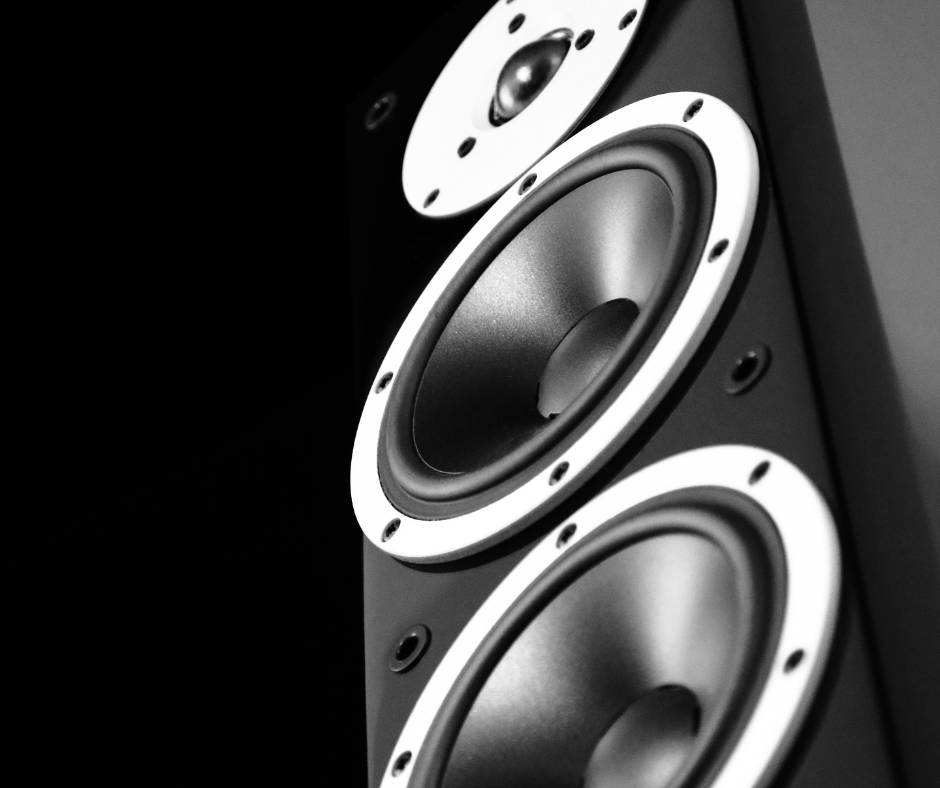
Tower speakers are full-range floorstanding loudspeakers engineered to energise larger spaces with deeper bass, wider dispersion and higher dynamic output than compact speakers can provide. Their tall enclosures, multi-driver arrays and powerful low-frequency capabilities are designed to fill medium and large rooms with immersive, room-scale sound that smaller speakers cannot replicate.
The Design Characteristics That Favour Larger Rooms
Floorstanding speakers—often containing multiple woofers, a dedicated midrange driver and a high-frequency tweeter—produce significant acoustic energy across the entire frequency spectrum. These characteristics benefit from the physical volume and listening distance that larger rooms provide. Find out more with the What Are Floorstanding Speakers guide.
1. Deeper Bass Requires More Physical Space
Tower speakers extend further into the low-frequency region, often reaching 30 Hz or lower. Deep bass wavelengths are long, several metres in length, so they require space to develop cleanly.
In Larger Rooms:
- Bass waves fully unfold without excessive boundary pressure
- Room modes are distributed more evenly
- Less boominess due to greater air volume
- Smoother in-room response across the listening area
Small rooms amplify certain bass frequencies excessively, whereas larger rooms allow tower speakers to exhibit their natural low-frequency authority.
2. Greater Listening Distance Improves Integration
Tower speakers use vertically separated drivers - woofer, midrange and tweeter. These drivers integrate into a cohesive soundstage at a sufficient distance, which larger rooms inherently allow.
Benefits of Increased Listening Distance:
- Better driver blending across the frequency band
- Smoother vertical dispersion from taller cabinets
- More stable imaging free from phase overlap
- More natural sound projection
In small rooms, the integration point may occur behind the listener, making the presentation feel disjointed or overly bright.
3. Tower Speakers Need Space to Breathe
Larger rooms accommodate the recommended placement distances tower speakers require:
- 60–90 cm from the rear wall
- 50–100 cm from side walls
- 2–3 metres between speakers
- 2.5–4 metres to the listening position
These distances help minimise boundary gain, improve bass linearity and optimise imaging—something often impossible in smaller rooms.
4. Better Control of Reflections and Room Energy
Tower speakers generate strong direct sound and substantial reflected sound. Larger rooms improve acoustic balance by:
- Delaying early reflections from sidewalls, floors and ceilings
- Reducing reflection intensity due to greater distances
- Allowing better placement for acoustic treatment
Smaller rooms push reflective surfaces too close to the speaker, amplifying comb filtering, brightness and midrange glare.
5. More Room Volume for Dynamic Output
Tower speakers excel in dynamic range—producing impactful crescendos, lifelike vocals and realistic orchestral swells. This dynamic capability is best experienced in larger rooms where sound can expand naturally.
Why Dynamics Thrive in Bigger Spaces:
- More air volume allows pressure changes to feel natural
- Higher SPL levels can be enjoyed without overwhelming the listener
- Greater distance prevents listener fatigue
Large-scale musical energy feels cramped in small rooms, especially at higher listening volumes.
6. Soundstage Size Matches Cabinet Architecture
Floorstanding speakers project sound with height and width that reflect their cabinet design. Larger rooms allow this soundstage to expand fully.
Soundstage Benefits in Larger Rooms:
- Taller images due to elevated driver placement
- Deeper soundstage depth because reflections arrive later
- Wider stereo spread from increased speaker separation
Smaller rooms compress the spatial presentation, making the soundstage feel narrow or overly intimate.
7. Reduced Room-Induced Colouration
Tower speakers can excite problematic resonances in small rooms, particularly between 40–120 Hz. Larger rooms typically produce:
- Less severe modal peaks and nulls
- More uniform bass energy distribution
- Lower levels of cabinet reinforcement from nearby surfaces
These benefits improve tonal accuracy and bass clarity which are core strengths of well-designed tower loudspeakers.
When Tower Speakers Can Work in Smaller Rooms
Although tower speakers shine brightest in larger rooms, they can still perform well in smaller spaces if carefully chosen and properly positioned.
Key Considerations for Small-Room Placement:
- Choose models with controlled bass tuning
- Prefer sealed or front-ported designs
- Use moderate listening distances
- Apply bass management or room correction when necessary
However, the full dynamic scale and acoustic presence of a tower speaker are only fully realised in larger environments.
For big, room-filling sound, browse our curated Floorstanding Speakers collection.
Final Thoughts
Tower speakers are engineered for presence, scale and authority—qualities that flourish in larger rooms. The deep bass, expanded soundstage, greater dispersion and stronger dynamic output of floorstanding speakers require physical space to develop properly. When matched to a room with adequate volume and appropriate listening distance, tower speakers deliver their signature immersive, full-bodied performance exactly as intended.