
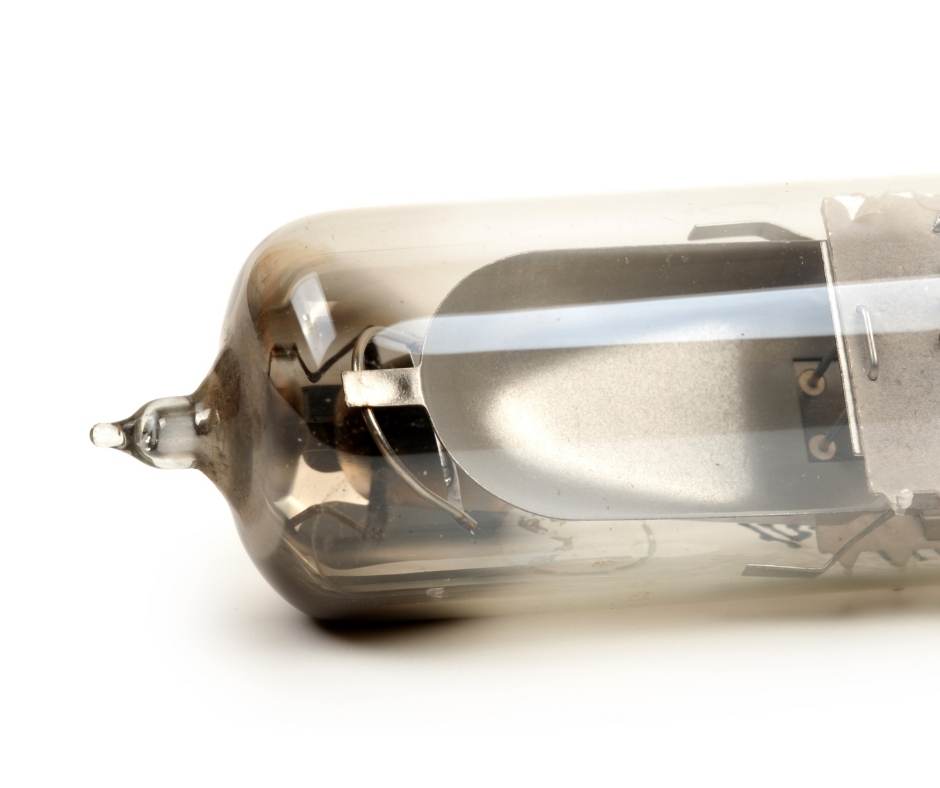
The difference between valve and solid-state amplifiers lies in how they amplify audio signals—valve amplifiers use vacuum tubes, while solid-state amplifiers use transistors—and this fundamental contrast creates distinct tonal, dynamic and maintenance characteristics. Each technology shapes sound in a unique way, influencing harmonic content, transient behaviour, headroom, durability and the overall listening experience.
How Valve Amplifiers Shape Sound
Valve amplifiers use vacuum tubes that operate through thermionic emission, creating a naturally compressive and harmonically rich sound. This behaviour reflects the fundamental operating principles of valve amplification, which are explained in detail in our guide to what a valve amplifier is, and it underpins the warmth, saturation and dynamic character associated with tube-based designs. The tube’s inherent nonlinearities produce second-order harmonics, which the human ear interprets as musical and natural.
Tonal Characteristics of Valve Amplifiers
- Warm, saturated midrange with smooth texture
- Pleasing harmonic richness from tube saturation
- Softer transient edges that reduce harshness
- Natural compression that enhances perceived musical engagement
- Expansive soundstage with three-dimensional imaging
These traits make valve amplifiers ideal for listeners who appreciate organic timbre and emotionally expressive playback.
Dynamic Behaviour
Valves exhibit soft clipping: when driven hard, they round off peaks gracefully rather than introducing aggressive distortion. This makes tube amplifiers sound more forgiving at higher volumes, even with limited wattage.
Where Valve Amplifiers Excel
- Vocal-heavy music, acoustic recordings and jazz
- High-sensitivity speakers (e.g., 92 dB+)
- Intimate rooms where tonal richness is valued over sheer output
Valve amplifiers also excel when paired with efficient loudspeakers, as their lower wattage, softer clipping behaviour and higher output impedance align naturally with sensitive designs—an interaction explored in detail in our guide to why valve amplifiers pair well with high-sensitivity speakers
How Solid-State Amplifiers Shape Sound
Solid-state amplifiers use transistors, which amplify signals through semiconductor switching rather than thermionic emission. They are engineered for linearity, efficiency and low distortion, providing clean and authoritative amplification.
Tonal Characteristics of Solid-State Amplifiers
- Tight, controlled bass from high damping factor
- Neutral, transparent midrange
- Crisp transient response with sharp leading edges
- High dynamic headroom suitable for difficult speakers
- Low noise floor and minimal coloration
Solid-state amplifiers appeal to listeners who prioritise accuracy, detail retrieval and maximum speaker control.
Dynamic Behaviour
When pushed beyond their limits, transistors exhibit hard clipping, which generates harsher, more abrupt distortion compared with valves. This makes adequate headroom essential in solid-state systems.
Where Solid-State Amplifiers Excel
- Large rooms requiring high SPL capability
- Low-sensitivity or difficult speaker loads
- Listeners who value neutrality and precision
- Systems where strong bass control is essential
Key Technical Differences
Harmonic Distortion Profile
- Valve amps: emphasise 2nd-order harmonics (pleasant, musical)
- Solid-state amps: emphasise higher-order harmonics (more analytical)
Damping Factor
- Valve amps: low damping → looser, more rounded bass
- Solid-state amps: high damping → tight, controlled bass
Power Output
- Valve amps: typically lower wattage but subjectively louder due to soft clipping
- Solid-state amps: high current and wattage, ideal for difficult loads
Efficiency
- Valve amps: low efficiency, high heat
- Solid-state amps: high efficiency, low heat
Maintenance Differences
Valve Amplifier Maintenance
Valve amplifiers require periodic upkeep because tubes are consumable components that gradually wear out.
- Tube replacement every 1–5 years depending on type
- Bias adjustment in some push-pull designs
- Heat management to prolong tube life
- Handling care as tubes are fragile and sensitive to vibration
Many enthusiasts consider this part of the charm, as tube rolling allows personal tuning of the amplifier’s sound.
Solid-State Amplifier Maintenance
Solid-state amplifiers are largely maintenance-free. They use durable semiconductor components that do not require periodic replacement.
- No tube replacements
- Minimal heat output increases long-term reliability
- Stable performance without bias drift
- Lower operating costs over time
Which Amplifier Type Is Right for You?
Both valve and solid-state amplifiers offer compelling strengths. The right choice depends on your listening priorities, room size, speakers and personal taste.
Choose a Valve Amplifier If You Want:
- A warm, immersive tonal character
- Natural compression and forgiving dynamics
- A tactile, emotionally engaging listening experience
- Compatibility with high-sensitivity speakers
Choose a Solid-State Amplifier If You Want:
- Maximum detail and transparency
- Strong bass control and high current delivery
- Minimal maintenance and long-term reliability
- Compatibility with low-impedance or difficult speakers
Looking to upgrade your system now? Explore our full Valve Amplifiers range.
Final Thoughts
Valve amplifiers deliver warmth, saturation and expressive character, while solid-state amplifiers offer precision, power and reliability. Neither technology is inherently superior—each provides a distinct listening experience shaped by its engineering principles. Understanding these differences helps you build a system that matches your musical tastes, room environment and long-term ownership expectations.


