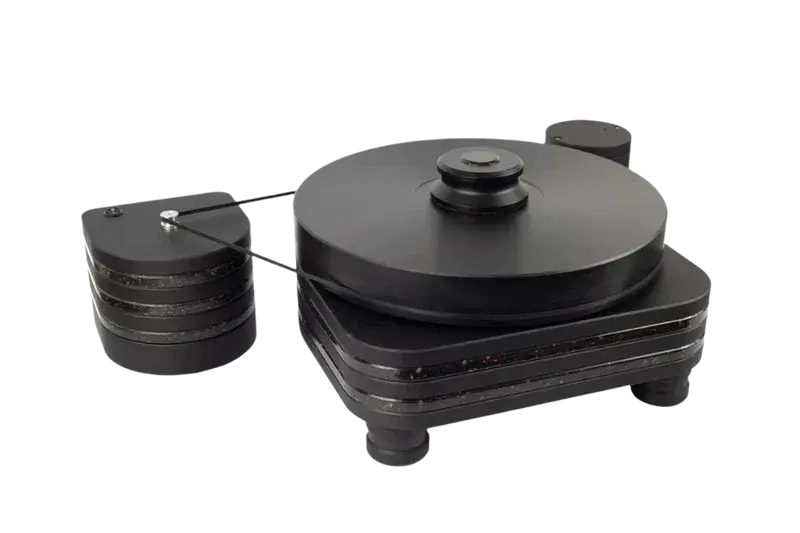

A turntable works by rotating a vinyl record at a stable speed while a stylus tracks the grooves and converts their physical modulations into an electrical audio signal. Understanding what a turntable is provides essential context before exploring how the plinth, motor, platter and tonearm work together to preserve musical detail.
The Plinth: The Foundation of Stability
The plinth is the turntable’s structural base. Its role is to provide rigidity, resist vibration and support the bearings, motor and tonearm with rock-solid stability.
What Makes an Effective Plinth?
- Mass: heavier plinths resist external vibration
- Damping: layered or composite materials reduce resonance
- Rigidity: prevents mechanical energy from influencing the stylus
Materials vary—wood composites, MDF, acrylic, aluminium, sandwich constructions—but the goal is always the same: prevent energy from feeding back into the stylus.
Material choice and structural design play a major role in vibration control. This is explored in more detail in our guide on plinth materials and build quality .
The Motor: Generating Stable Rotation
The motor drives the platter at constant speed—typically 33⅓ or 45 RPM. Any speed instability directly affects pitch, timing and musical flow.
Belt-Drive Motors
In belt-drive turntables, a rubber or silicone belt links the motor to the platter. The belt absorbs vibration, isolating the platter from motor noise.
Direct-Drive Motors
Direct-drive systems integrate the motor into the platter assembly. They offer excellent torque and immediate speed stability, relying on tight engineering to suppress motor noise.
Why Motor Quality Matters
A stable motor reduces wow (slow pitch drift) and flutter (fast instability), ensuring:
- accurate pitch
- clean sustained notes
- natural instrument timbre
High-quality motors are quiet, consistent and well-isolated from the tonearm and plinth.
The Platter: Maintaining Speed and Absorbing Resonance
The platter is the rotating surface that supports the record. Its mass, material and machining determine both rotational stability and resonance behaviour.
Platter Materials and Their Benefits
- Acrylic: naturally damped, smooth sound, often used without a mat
- Aluminium: rigid, stable, often paired with damping layers
- Glass: heavy and stable but requires additional damping
- Composite alloys: advanced damping and uniform rotation
Why Platter Weight Matters
A heavier platter maintains rotational inertia, reducing speed variation. However, excessive mass can strain motors unless engineered for it—hence the importance of system-matched components.
The Tonearm: Guiding the Stylus with Precision
The tonearm tracks the record groove, maintaining the correct geometry and applying precise downward force so the stylus can reproduce the waveform accurately.
Core Functions of a Tonearm
- Maintain correct cartridge alignment across the record’s radius
- Minimise friction so the stylus can track smoothly
- Control tracking force for optimal sound and record longevity
- Apply anti-skate to counter inward pull on the stylus
Tonearm Designs
- Static balance arms — simple and consistent
- Dynamically balanced arms — excellent tracking during vibration
- Gimbal bearings — low-friction precision bearings
- Unipivot arms — highly resolving, require careful setup
A well-designed tonearm allows the cartridge to perform at its full potential.
Even the most precise mechanical design relies on correct calibration. A proper turntable setup ensures accurate tracking and long-term record care.
The Cartridge: Converting Movement into Sound
Although not part of the structural mechanics, the cartridge is central to the process. It translates groove modulations into electrical signals using either a moving magnet (MM) or moving coil (MC) generator.
Stylus Shapes
- Elliptical: balanced performance
- Microline: excellent detail and tracking
- Shibata: extended frequency response
- Conical: forgiving and warm
Stylus shape affects everything from tracking accuracy to noise floor and stereo imaging.
How All Components Work Together
A turntable’s performance is the sum of its parts. For example:
- The plinth absorbs vibration so the tonearm can track accurately.
- The motor maintains stable speed so pitch and timing stay correct.
- The platter provides rotational inertia and damping.
- The tonearm ensures the stylus follows the groove with minimal resistance.
If any component introduces noise, instability or misalignment, the entire system is compromised.
Why Build Quality Matters
Turntables operate at microscopic tolerances: a tiny displacement or vibration at the stylus becomes a major sonic artefact once amplified.
Quality materials, precise machining and effective isolation deliver:
- cleaner detail
- wider soundstage
- lower noise floor
- more natural rhythm and timing
This is why even modest turntables benefit from careful engineering and setup.
Building a vinyl system? Explore our curated range of Turntables.
Final Thoughts
A turntable works by combining mechanical stability, precise rotation and accurate groove tracking to extract music from vinyl with clarity and vibrancy. The plinth controls resonance, the motor maintains speed, the platter stabilises rotation and the tonearm enables the stylus to trace the groove faithfully. When these elements are well executed, the result is a warm, dynamic and engaging analogue listening experience unmatched by digital formats.