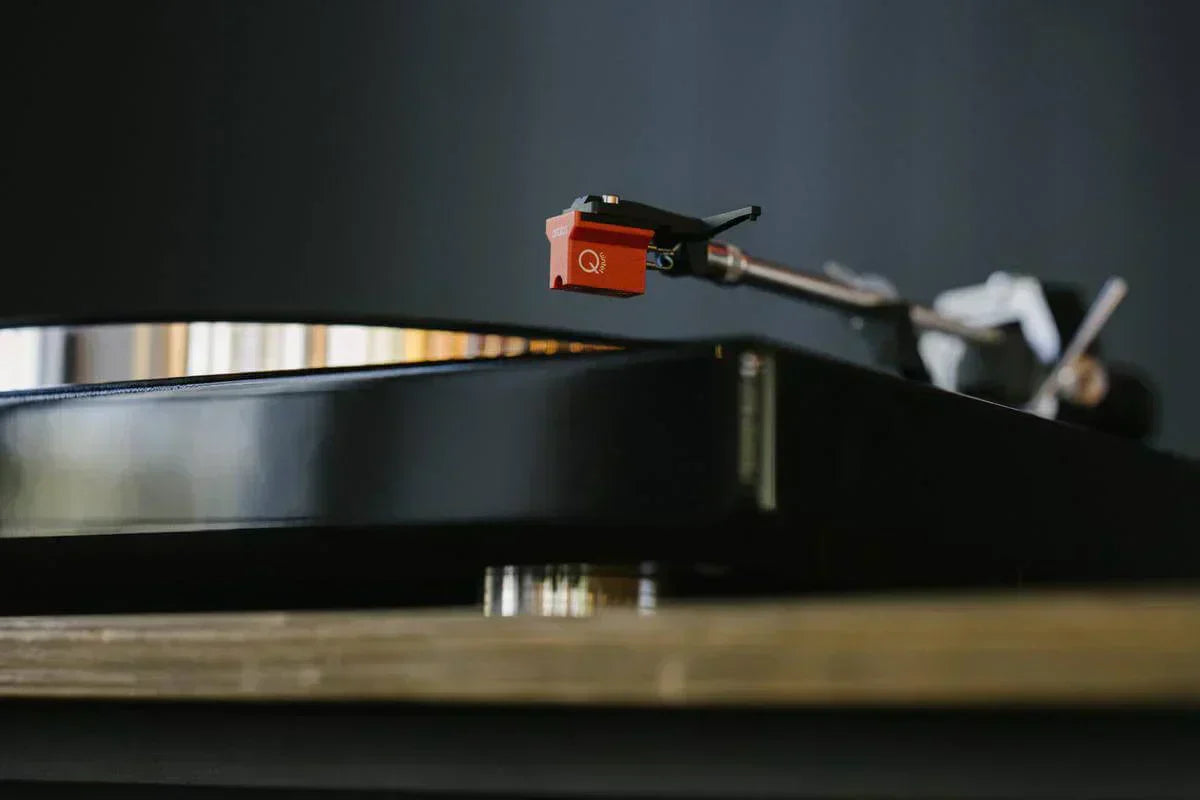

Turntable noise is any unwanted mechanical or acoustic vibration that reaches the stylus and becomes amplified as hum, rumble, footfall noise or low-frequency feedback. Because vinyl playback is a mechanical process, reducing vibration and isolating the turntable from external energy is essential for achieving clean, stable and distortion-free sound. Understanding what a turntable is helps explain why isolation and vibration control play such a critical role in analogue performance.
Why Turntables Are Sensitive to Vibration
A stylus traces microscopic groove modulations only microns wide. Any additional movement—whether from the floor, speakers, motor or airborne energy—can mask detail, blur imaging or cause audible distortion.
Turntable noise typically comes from three places:
- Environmental vibration (floors, furniture, footsteps)
- Acoustic energy (bass waves from speakers)
- Mechanical vibration (motor noise, bearing noise, resonance)
Effective isolation requires managing all three.
1. Improve the Turntable’s Foundation
The stand, shelf or furniture beneath the turntable has a dramatic impact on performance.
Use a Solid, Rigid Surface
Lightweight furniture resonates, transmitting vibration straight into the plinth. A heavy, stable surface reduces resonance and improves bass clarity.
Dedicated Turntable Racks
Purpose-built racks use materials and geometry designed to disperse energy. They resist horizontal and vertical resonance better than standard furniture.
Wall Shelves
In rooms with springy floors, a wall-mounted shelf isolates the turntable completely from footfall noise—often the single most effective solution.
2. Add Isolation Under the Turntable
Isolating feet and platforms reduce vibration transmission between the turntable and its support surface.
Types of Isolation Feet
- Rubber or elastomer feet: basic but effective for mid-frequency vibration
- Spring-based feet: excellent for footfall noise and low-frequency resonance
- Gel or sorbothane feet: strong damping across a wide frequency range
- Magnetic levitation feet: premium isolation for high-end systems
Choosing the right type depends on floor type, rack stability and system sensitivity.
Isolation Platforms
Platforms made from acrylic, bamboo, MDF composites, constrained-layer damping or granite absorb and distribute vibration before it reaches the plinth. Some feature springs or internal damping chambers for enhanced stability.
3. Control Acoustic Feedback
Low-frequency energy from speakers can cause the turntable to resonate sympathetically, producing a feedback loop.
How to Prevent Acoustic Feedback
- Move the turntable further from speakers
- Increase plinth mass or use damping mats
- Angle speakers away from the turntable
- Place the turntable on a different wall or surface
- Install better isolation feet under the turntable
Bass-heavy rooms are especially prone to feedback; placement adjustments often produce immediate improvements.
Structural vibration often travels through the plinth and support surface. This is closely related to how plinth mass and construction affect energy dissipation, which we explore in more detail in our guide on plinth material and build quality .
4. Reduce Motor Noise and Internal Resonance
Even the best motors generate small amounts of mechanical vibration. Without damping, this vibration travels through the plinth and tonearm into the stylus.
Solutions for Motor Noise
- Replace worn belts on belt-drive systems
- Ensure pulleys spin freely and are correctly lubricated
- Upgrade to motors with lower noise floors if supported
- Check for loose mounts or screws around the motor housing
Improve Internal Damping
- Use damping mats on the platter
- Add damping material inside hollow plinths (if designed for it)
- Ensure tonearm bearings are tight and aligned
Reducing mechanical vibration improves micro-detail, transients and soundstage precision.
5. Control External Vibrations
Environmental vibrations—doors closing, footsteps, subwoofer output—can easily disrupt playback.
Key Techniques
- Decouple the turntable from the floor using wall shelves or isolation platforms
- Keep the turntable away from HVAC vents, doors and foot-traffic zones
- Avoid placing it on the same furniture as powerful amplifiers or speakers
6. Use the Right Record Mat
The mat influences resonance control between the record and platter.
- Rubber — high damping, good for noisy environments
- Felt — soft and airy but offers minimal damping
- Cork — controlled grip and moderate damping
- Acrylic mats — rigid and resonance-resistant
- Leather — warm tonality and effective mid-frequency damping
Matching the mat to the platter material can significantly lower mechanical noise.
7. Check Cartridge Setup
Incorrect alignment or tracking force increases groove noise and stylus chatter.
- Set tracking force to the manufacturer’s recommended range
- Verify overhang, azimuth and VTA
- Ensure anti-skate is correctly dialled in
Proper alignment reduces friction-induced noise and improves clarity.
8. Combine Isolation With Room Layout
The best isolation solutions work together with smart placement.
- Avoid corners and resonant shelves
- Separate speakers from the turntable path
- Use heavy furniture for stability
- Position the system away from foot-traffic areas
A well-planned layout prevents most noise problems before they begin.
Building a vinyl system? Explore our curated range of Turntables.
Final Thoughts
Reducing turntable noise requires controlling vibration at every stage—foundation, isolation, acoustic environment and internal mechanics. By combining stable support, effective damping, proper placement and correct cartridge setup, you can dramatically lower noise, reveal finer musical detail and improve overall analogue performance. With proper isolation, even modest turntables achieve cleaner, clearer and more engaging sound from your vinyl collection.